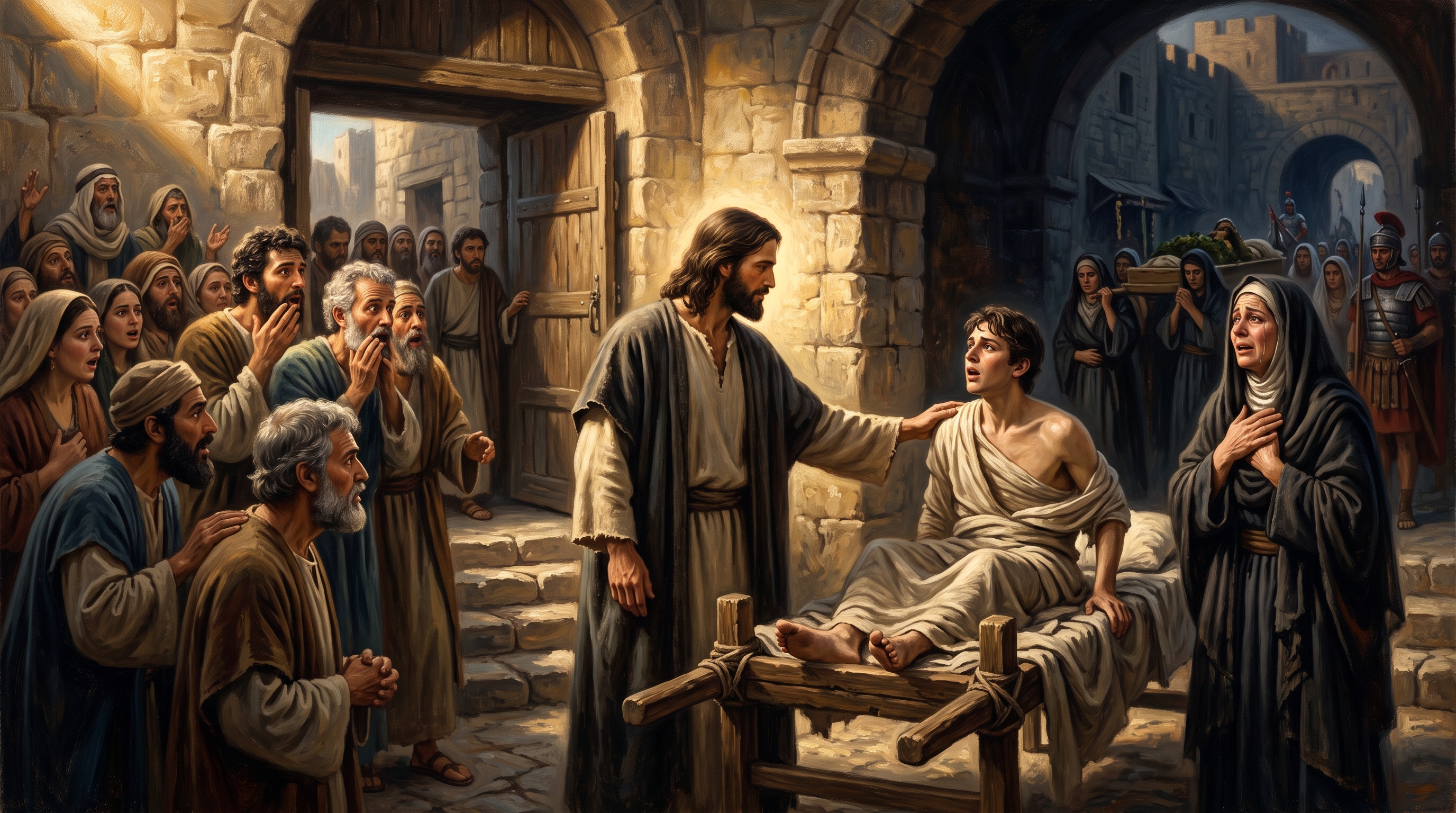
The Widow of Nain and the Echoes of Zarephath
“And the dead man sat up and began to speak, and Jesus gave him to his mother.” — Luke 7:15
The Meeting of Two Crowds at Nain
The narrative of Luke 7:11–17 opens at the gates of Nain, where two crowds meet. Jesus approaches the city accompanied by his disciples and a large crowd (ochlos polys). At the same time, a funeral procession emerges from the city, carrying a dead man who is described as the only son (monogenēs) of his mother, a widow (chēra). She, too, is accompanied by a considerable crowd from the city. Luke structures the encounter around these opposing movements: one crowd entering with Jesus, the other leaving with the dead.
The emotional gravity of the scene is intensified by the woman's circumstances. The death of an only son for a widow was not merely a profound personal loss. In the social world of antiquity, the loss of her remaining immediate male family member could also leave her particularly vulnerable economically and socially. By supplying these details, Luke brings bereavement and vulnerability together in the figure of the widow.
The Compassion of the Lord
In Luke 7:13, the narrator introduces the decisive movement: “And when the Lord saw her, he had compassion on her and said to her, ‘Do not weep.’” Luke's use of “the Lord” (ho kyrios) deserves attention. While characters may address Jesus as “lord” in various senses, here the designation belongs to the narrator's description of Jesus within the scene. It accompanies an action characterized not first by a request from the widow, but by Jesus' own initiative.
The verb splagchnizomai, translated “had compassion,” describes a deep movement of pity or mercy. Yet the narrative force does not depend upon the etymology of the term. What matters is what follows. The widow does not ask Jesus to raise her son. No intermediary petitions him. Jesus sees her, has compassion, approaches the bier, and acts. He tells the mother, “Do not weep.” Then he touches the bier, and the bearers stand still.
The Echo of Zarephath
The Nain miracle strongly evokes one of Israel's best-known prophetic narratives: Elijah's restoration of the widow's son at Zarephath in 1 Kings 17:8–24. The parallels are substantial. Both narratives concern a widow and her dead son. In both, the son is restored to life, and in both the narrative culminates with the restored son being returned to his mother.
The verbal echo at this point is especially important. In the Septuagint of 1 Kings 17:23, after Elijah brings the child down from the upper room, the text says that he “gave him to his mother” (kai edōken auton tē mētri autou). Luke 7:15 uses the same wording after the young man sits up and begins to speak: “and he gave him to his mother” (kai edōken auton tē mētri autou). This shared wording, together with the wider narrative parallels, strongly suggests that Luke is deliberately evoking the Elijah narrative. The reader is being directed back into the prophetic world of Zarephath.
Narrative Correspondence and Divergent Agency
Yet Luke does more than reproduce the earlier pattern. The similarity between the two accounts makes their difference in agency particularly noticeable. In 1 Kings 17, Elijah takes the dead child from his mother, carries him to the upper room, lays him upon his own bed, and cries out to YHWH. He stretches himself upon the child three times and petitions, “O LORD my God, let this child's life come into him again” (1 Kgs 17:21). The narrator then identifies the source of the restoration: “And the LORD listened to the voice of Elijah. And the soul of the child came into him again, and he revived” (1 Kgs 17:22).
At Nain, Jesus does not withdraw with the dead man or offer a narrated petition. He approaches the funeral bier and addresses the dead man himself:
“Young man, I say to you, arise.”
The young man responds. He sits up and begins to speak. When the two accounts are placed alongside one another, the distinction is difficult to miss: Elijah petitions YHWH for the child's life to return; Jesus speaks to the dead man, and the dead man responds to his command.
The Prophetic Category and Its Limits
The crowd's reaction in Luke 7:16 fits naturally within this scriptural background: “Fear seized them all, and they glorified God, saying, ‘A great prophet has arisen among us!’” The designation should not be dismissed as though the crowd has simply misunderstood what has occurred. Within Israel's scriptural world, the raising of a widow's son provides an obvious reason to remember Elijah.
Luke has already prepared his readers for precisely this association. In Luke 4:25–26, during Jesus' address at Nazareth, he recalls that although there were many widows in Israel during Elijah's time, the prophet was sent to “a widow at Zarephath in Sidon.” By Luke 7, the reader has therefore already been explicitly reminded of Elijah and the widow of Zarephath.
Against this background, the crowd's declaration that a great prophet has arisen is entirely fitting. The prophetic identification is therefore not something to explain away. The remaining question is whether it exhausts what Luke's narrative places before the reader.
The Visitation of God
The crowd does not stop with the declaration that a great prophet has arisen. It offers a second interpretation:
“God has visited his people!” — Luke 7:16
The language of visitation belongs to an important Lukan pattern. In the Benedictus, Zechariah blesses the God of Israel because “he has visited and redeemed his people” (Luke 1:68). Later, Jesus laments over Jerusalem because it “did not know the time of your visitation” (Luke 19:44). The vocabulary describes decisive divine intervention within the history of God's people.
At Nain, the crowd glorifies God and interprets the event as divine visitation. This need not mean that the crowd possesses a developed theological understanding of Jesus' identity. Within the prophetic framework already established by the narrative, their words can naturally mean that God has acted among his people through the prophet before them. Yet Luke places the declaration immediately after the actions of Jesus. Jesus sees the widow. Jesus has compassion. Jesus approaches the bier. Jesus speaks to the dead. The young man rises. The crowd then declares that God has visited his people. The narrative thus places God's visitation and the action of Jesus in remarkably close relation.
The Evidence of the Coming One
The significance of Nain becomes clearer from what Luke narrates immediately afterward. In Luke 7:18–23, disciples of John the Baptist come to Jesus with a question:
“Are you the one who is to come, or shall we look for another?”
Jesus responds by directing them to what is happening:
“The blind receive their sight, the lame walk, lepers are cleansed, and the deaf hear, the dead are raised up, the poor have good news preached to them.”
The language draws particularly upon Isaiah's promises of restoration, including Isa 35:5–6 and Isa 61:1. The opening of blind eyes within Isaiah's expectation of God's coming salvation has been explored more fully in Then Shall the Eyes of the Blind Be Opened. Here the connection serves a narrower purpose: Luke places the raising at Nain immediately before Jesus declares that “the dead are raised,” making the widow's son part of the narrative evidence concerning “the one who is to come.”
The progression matters. John's messengers ask about the identity of the coming one immediately after Luke has narrated Jesus restoring a dead man to life. The miracle at Nain therefore becomes part of Luke's developing answer to the question John's disciples bring.
Conclusion
The raising of the widow's son at Nain places Jesus unmistakably within Israel's prophetic memory. Luke has led the reader back to Elijah and Zarephath, but the crowd's response now carries the episode beyond simple narrative resemblance.
The crowd reaches for the category Israel's Scriptures have given them:
“A great prophet has arisen among us.”
Yet their second declaration places the event within a larger theological horizon:
“God has visited his people.”
Luke leaves both declarations standing.
The prophet has arisen. God has visited. And between them stands Jesus, speaking to the dead.