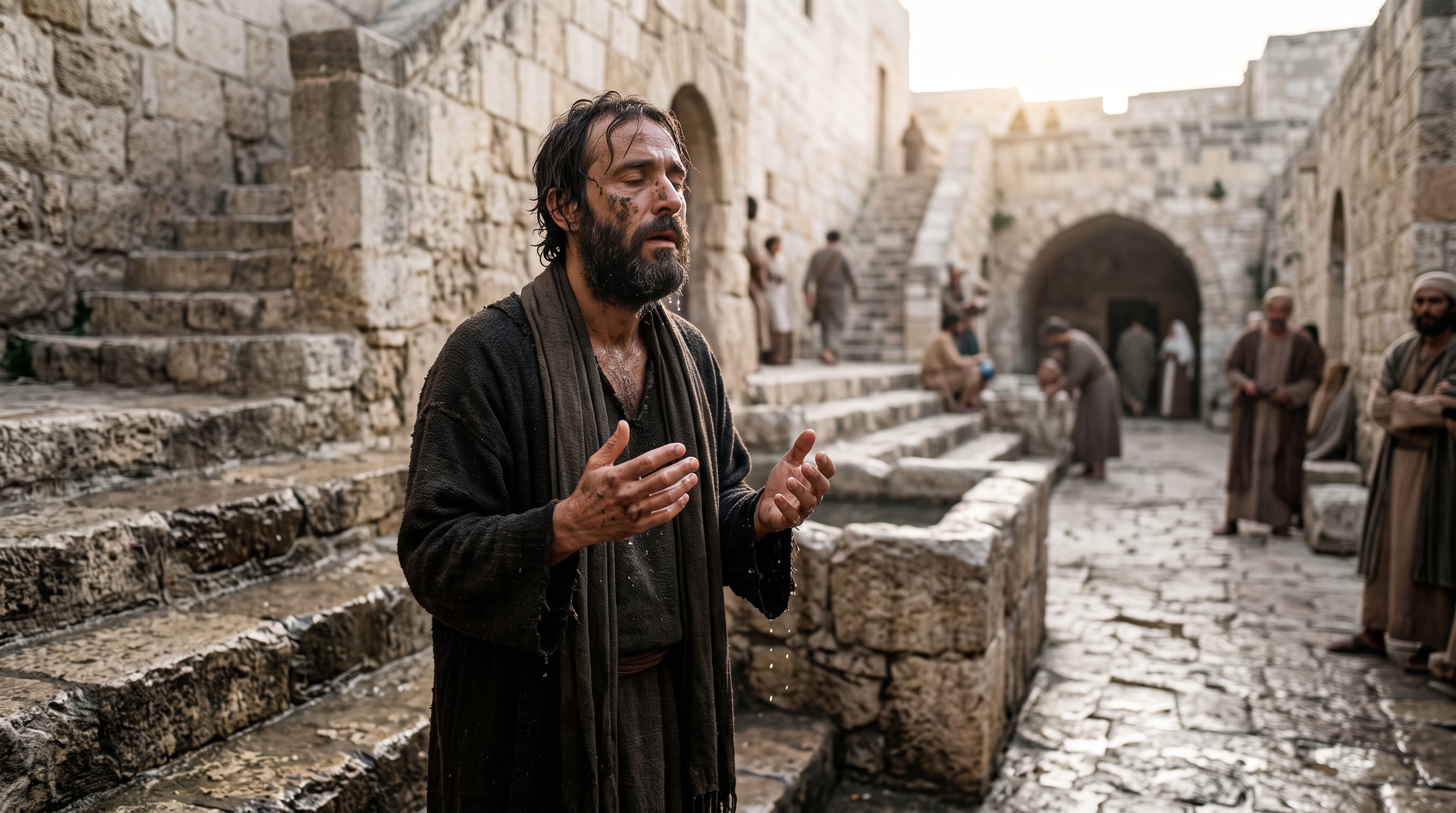
Isaiah 35 and the Man Born Blind
“Then the eyes of the blind shall be opened, and the ears of the deaf shall be unstopped.”
— Isa 35:5
A Man Blind from Birth
John introduces the man with almost no biographical information. He is simply “a man which was blind from his birth” (John 9:1). That qualification governs everything that follows. This is not the recovery of sight once possessed; there is no former condition to which he can return. He has never seen.
The disciples immediately ask for a cause: “Master, who did sin, this man, or his parents, that he was born blind?” Jesus rejects both alternatives: “Neither hath this man sinned, nor his parents: but that the works of God should be made manifest in him” (John 9:2–3). Their attention is fixed upon what preceded the blindness, but Jesus directs it toward what is about to happen. “I must work the works of him that sent me, while it is day,” He continues (John 9:4).
Elsewhere in John, Jesus repeatedly speaks of His works in relation to the Father who sent Him (John 5:19–20, 36; 10:25, 37–38; 14:10–11). John 9 begins within that relationship: what follows is presented as the work of God carried out by the one He has sent.
Jesus then “spat on the ground, and made clay of the spittle, and he anointed the eyes of the blind man with the clay” (John 9:6). He sends the man to wash in the pool of Siloam, a name John translates as “Sent.” The result is given with extraordinary economy: “He went his way therefore, and washed, and came seeing” (John 9:7). The miracle itself is over almost as soon as it begins. The greater part of the chapter concerns what happens after the man can see.
The Clay
The clay has often invited comparison with Genesis 2, where “the LORD God formed man of the dust of the ground, and breathed into his nostrils the breath of life” (Gen 2:7). The possibility deserves consideration in a Gospel that begins with “In the beginning” and introduces creation, life, and light within its opening verses (John 1:1–5). John, however, does not cite Genesis 2 or explain the clay in those terms. Saliva also appears elsewhere in the Gospel tradition in connection with healing (Mark 7:32–35; 8:22–25). It would therefore be unwise to make the clay carry an argument John never explicitly assigns to it.
Even so, the circumstances are unusual. Jesus works with the ground before giving sight to a man whose eyes have never seen (John 9:6–7). Within a Gospel already framed by creation language, the scene may suggest more than the repair of an injury. John leaves the detail unexplained, and it is best left with that measure of restraint. Isaiah gives us firmer ground.
“Your God Will Come”
Isa 35 describes a world changed by the salvation of God. The wilderness rejoices, the desert blossoms, weak hands are strengthened, and fearful hearts are told:
“Behold, your God will come with vengeance, even God with a recompence; he will come and save you.”
— Isa 35:4
The next words describe what accompanies that coming:
“Then the eyes of the blind shall be opened, and the ears of the deaf shall be unstopped. Then shall the lame man leap as an hart, and the tongue of the dumb sing.”
Isaiah first announces, “Your God will come,” and then speaks of blind eyes opening. Sight belongs to his portrait of salvation arriving among the people. Isa 29 looks toward the same hope, when “the eyes of the blind shall see out of obscurity, and out of darkness” (Isa 29:18).
Isa 42 adds an important qualification. There YHWH is identified as the Creator who “created the heavens, and stretched them out,” and who “giveth breath unto the people upon it” (Isa 42:5). He then addresses His servant:
“I the LORD have called thee in righteousness, and will hold thine hand, and will keep thee... to open the blind eyes, to bring out the prisoners from the prison.”
The prophet therefore speaks in two ways. In Isa 35, blind eyes open when YHWH comes to save; in Isa 42, YHWH commissions His servant to open blind eyes. Both belong to Isaiah’s expectation, and neither should be suppressed for the sake of an easier argument. John 9 does not ask the reader to infer the identity of Jesus from the miracle alone. Instead, the healing begins an inquiry that occupies the rest of the chapter. A man has received sight from Jesus, and now everyone wants to know what kind of man could have done it.
“A Man That Is Called Jesus”
When the neighbors ask how his eyes were opened, the man answers plainly: “A man that is called Jesus made clay, and anointed mine eyes” (John 9:10–11). He knows the name of his healer, but little more. More importantly, he has never seen Him. Jesus anointed the man while he was blind and sent him to Siloam. His sight came only after he washed (John 9:6–7). By the time he returned seeing, Jesus was no longer present. When the neighbors ask where He is, the man answers, “I know not” (John 9:12). He has received sight from someone whose face he does not know.
The Pharisees then ask for his judgment concerning Jesus. His answer advances beyond the first: “He is a prophet” (John 9:17). The Sabbath complicates the matter. John notes that “it was the sabbath day when Jesus made the clay, and opened his eyes” (John 9:14). Some conclude, “This man is not of God, because he keepeth not the sabbath day,” while others are less certain: “How can a man that is a sinner do such miracles?” (John 9:16). The healing has produced not agreement but division.
The authorities then question whether the man had really been blind. His parents confirm both his identity and his congenital blindness but decline to explain how he now sees (John 9:18–23). The man is summoned again and told, “Give God the praise: we know that this man is a sinner” (John 9:24). His answer is difficult to argue away:
“Whether he be a sinner or no, I know not: one thing I know, that, whereas I was blind, now I see.”
The questioning continues until the man begins to challenge his interrogators. “Since the world began was it not heard that any man opened the eyes of one that was born blind” (John 9:32). The statement belongs to the healed man, not to the Evangelist speaking independently, but his reasoning is clear. Scripture promised the opening of blind eyes (Isa 29:18; 35:5; 42:7), yet it contained no account of someone blind from birth receiving sight. He therefore concludes, “If this man were not of God, he could do nothing” (John 9:33).
The response is immediate: “Thou wast altogether born in sins, and dost thou teach us?” (John 9:34). They cast him out. Their accusation returns the narrative to its beginning. The disciples had asked whether the man was born blind because of sin (John 9:2), and Jesus had rejected that premise (John 9:3). Now the same assumption is used to dismiss the testimony of the man whose eyes have been opened.
Learning Who Jesus Is
The man’s understanding of Jesus changes as the interrogation proceeds. At first He is “a man that is called Jesus” (John 9:11). Then He is “a prophet” (John 9:17). Finally, the man insists that He must be “of God” (John 9:33). His interrogators travel in the opposite direction. The man who began without physical sight becomes increasingly perceptive about Jesus, while those examining him possess sight and knowledge of the law yet become increasingly unwilling to reconsider their judgment.
John does not portray all the Pharisees identically. Some openly question how a sinner could perform such works (John 9:16). The division matters because it shows that the miracle itself demands interpretation. Everyone sees the same result, but they do not all see what it means. After the man is expelled, Jesus returns.
“Thou Hast Both Seen Him”
Jesus hears what has happened and finds the man:
“Jesus heard that they had cast him out; and when he had found him, he said unto him, Dost thou believe on the Son of God?”
By this point the man has testified about Jesus, defended the work He performed, and been cast out because he refused to condemn Him. Yet he has still never knowingly looked upon the one who gave him sight. He asks, “Who is he, Lord, that I might believe on him?” Jesus answers:
“Thou hast both seen him, and it is he that talketh with thee.”
Those words gather the chapter around the act of seeing. The man received physical sight at Siloam, but only now does he see the one responsible for it. “Lord, I believe,” he says, and John adds, “And he worshipped him” (John 9:38). The healing of his eyes occurred in verse 7; his recognition of Jesus has taken the rest of the chapter.
“Are We Blind Also?”
Jesus now turns the imagery of the miracle upon those who have witnessed its aftermath:
“For judgment I am come into this world, that they which see not might see; and that they which see might be made blind.”
Some of the Pharisees hear Him and ask, “Are we blind also?” (John 9:40). Jesus replies:
“If ye were blind, ye should have no sin: but now ye say, We see; therefore your sin remaineth.”
The man’s blindness has ceased to be the central problem. He can see, and he has also come to know who opened his eyes. The question of blindness now falls upon those who examined him, questioned his parents, rejected his testimony, and claimed certainty about Jesus.
Isaiah had promised that when God came to save, “the eyes of the blind shall be opened” (Isa 35:4–5). He had also spoken of the servant commissioned “to open the blind eyes” (Isa 42:6–7). John brings both expectations into a story in which the giving of sight begins, rather than ends, the inquiry into Jesus.
The chapter begins with a man who has never seen. It ends with that man looking upon Jesus, believing, and worshipping, while those who say, “We see,” remain under the judgment of their own claim (John 9:38–41).
Behind this scene lies a larger biblical question: how Scripture distinguishes God from the one He sends while also placing that figure within the revelation of God’s own saving presence. This question is explored more fully in No Other Beside Me: The Disclosure of the Single Subject, particularly in its treatment of divine agency, manifestation, and the identity of the Servant.