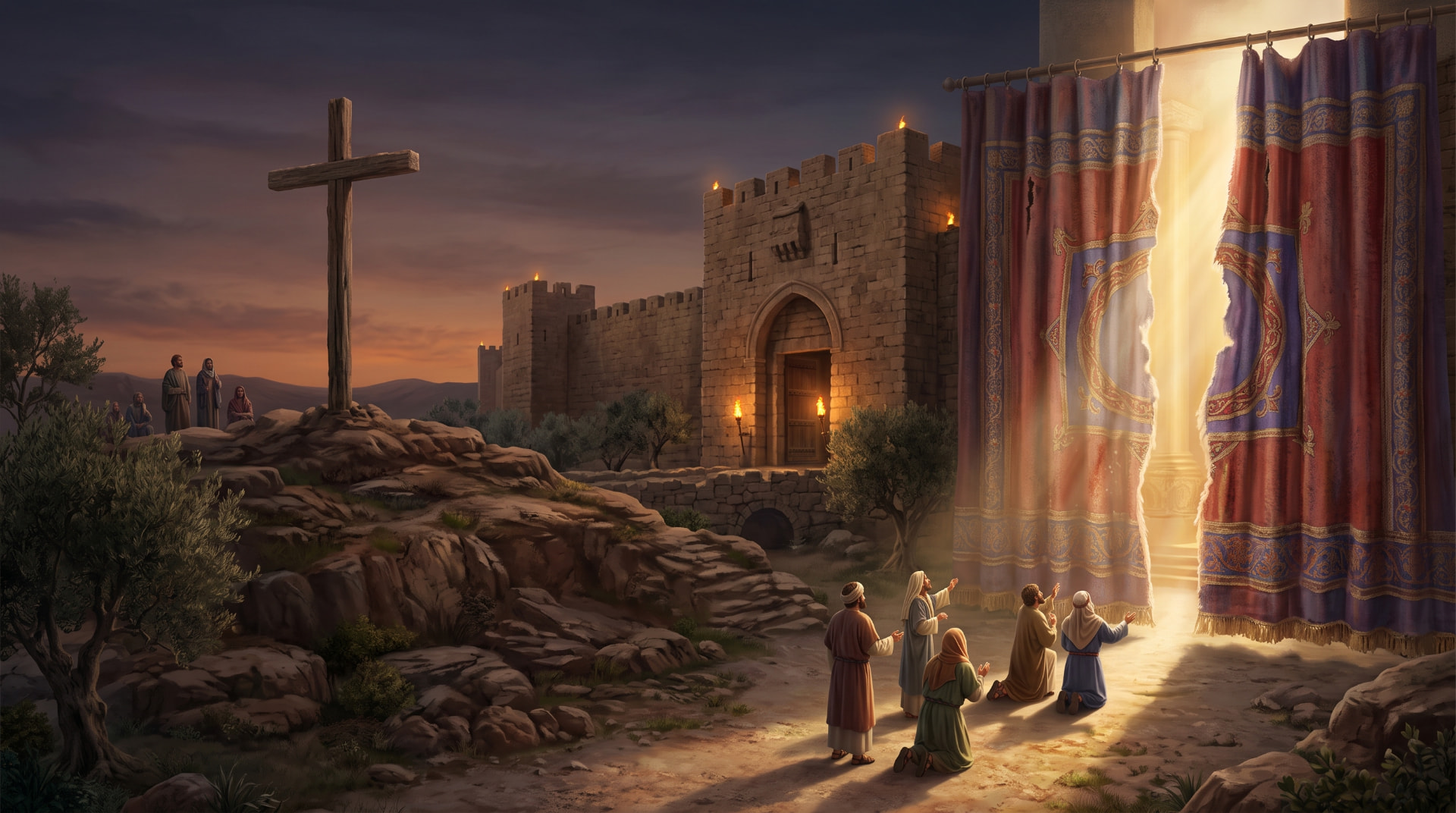
Cleansing and Access to God’s Presence
"Wherefore Jesus also, that he might sanctify the people with his own blood, suffered without the gate. Let us go forth therefore unto him without the camp, bearing his reproach." (Hebrews 13:12–13, KJV)
1. Introduction: Thesis and Method
Under the Mosaic covenant, access to God’s holy dwelling was guarded by boundaries, priestly mediation, and cleansing rites. In the Gospels, Jesus approaches individuals bearing ceremonial uncleanness, healing and restoring them. Through His death outside the gate and His entrance into the heavenly sanctuary, He opens bold access for a people cleansed by His blood, approaching the Father through Him as their High Priest, and becoming God’s dwelling through the Spirit. The canonical vision concludes in the New Jerusalem, where God and the Lamb are its temple and nothing that defiles enters.
Method and Standards of Evidence
This study works within canonical Scripture using the King James Version. Hebrew and Greek terms appear only to clarify wording. To maintain precision between what a text directly affirms and what is drawn by canonical connection, claims are weighed by four evidentiary warrants:
- Direct Statement: What a biblical text explicitly asserts.
- Explicit Interpretation: An inspired writer's direct explanation of an earlier text, event, or institution (e.g., Hebrews 9:8; 13:11–12).
- Strong Pattern: A typological or thematic connection supported by shared wording, narrative sequence, and canonical context.
- Possible Echo: A suggestive resonance that enriches a reading without establishing a formal link on its own.
2. The Architecture of Guarded Access: The Mosaic Order
The wilderness sanctuary was erected that the LORD might dwell among His covenant people: "And let them make me a sanctuary; that I may dwell among them" (Exodus 25:8). Yet the divine presence in the camp required an ordered structure of guarded approach:
| Sacred Boundaries Across the Camp and Sanctuary | Permitted Presence | Governed Access & Boundaries |
|---|---|---|
| Outside the Camp | The excluded, uncleansed, and refuse | Levitical exclusions (Lev 13:46; Num 5:1–4) |
| The Camp of Israel | The cleansed covenant congregation | Encamped about the tabernacle at a distance (Num 2:2) |
| The Court of the Tabernacle | Israelite worshippers bringing offerings | Altar of burnt offering and the laver (Exod 40:6–7) |
| The Holy Place | The consecrated priesthood | Daily service, table of shewbread, candlestick (Exod 40:22–26) |
| The Most Holy Place | The High Priest alone, once a year | The ark and mercy seat, entered not without blood (Lev 16:2; Heb 9:7) |
This spatial pattern was established at Sinai: "And thou shalt set bounds unto the people round about, saying, Take heed to yourselves, that ye go not up into the mount, or touch the border of it: whosoever toucheth the mount shall be surely put to death" (Exodus 19:12).
Around the tabernacle, this boundary took ceremonial and architectural form. Different forms of ritual uncleanness carried distinct restrictions rather than a uniform quarantine:
- The person with leprosy was commanded: "He is unclean: he shall dwell alone; without the camp shall his habitation be" (Leviticus 13:46).
- Bodily issues and contact with a human corpse required specified washings and periods of separation before full reintegration, "that they defile not their camps, in the midst whereof I dwell" (Numbers 5:2–3; Leviticus 15:1–13; Numbers 19:11–13).
- The ordinary worshipper brought offerings to the altar within the court, but was barred from entering the tent of the congregation (Numbers 18:22).
- The priests ministered in the Holy Place, while the inner veil separated them from the ark of the testimony (Exodus 26:33).
Hebrews directly interprets this restricted structure: "The Holy Ghost this signifying, that the way into the holiest of all was not yet made manifest, while as the first tabernacle was yet standing" (Hebrews 9:8). Access was provided within the covenant, yet bounded by veil, priesthood, and sacrificial blood.
3. Cleansing and Restoration in the Ministry of Jesus
Under the Levitical code, contact with ritual uncleanness communicated contamination to the person touching it, requiring washing or separation (Leviticus 11:39–40; 15:5–11; Numbers 19:11). In the Gospels, Jesus repeatedly encounters individuals marked by physical disease and ritual impurity:
Encounters with the Excluded
- The Leper: When a leper petitioned Him, "Jesus, moved with compassion, put forth his hand, and touched him, and saith unto him, I will; be thou clean. And as soon as he had spoken, immediately the leprosy departed from him, and he was cleansed" (Mark 1:41–42). Jesus touches the man and commands his cleansing; the leprosy leaves him, and Jesus directs him to show himself to the priest and offer the gifts commanded by Moses "for a testimony unto them" (1:44).
- The Woman with the Issue: A woman subject to an issue of blood for twelve years—a condition carrying ceremonial restrictions under Leviticus 15:25—approached Him in the press: "she came behind him, and touched the border of his garment: and immediately her issue of blood stanched" (Luke 8:44). Jesus states that virtue had gone out of Him, and tells the woman, "thy faith hath made thee whole; go in peace" (8:46–48).
- The Bier at Nain: Approaching the gate of Nain as a deceased young man was carried out, Jesus "came and touched the bier: and they that bare him stood still. And he said, Young man, I say unto thee, Arise. And he that was dead sat up, and began to speak" (Luke 7:14–15).
The narratives focus directly on physical healing, the cessation of affliction, and the restoration of life. At the same time, when read against the Levitical background, these episodes form a strong pattern: Jesus moves freely among conditions that carried ritual restriction under the law, and rather than contracting uncleanness through touch, His power removes the affliction and restores the person to communal and worship life.
4. Outside the Gate, Within the Veil
The redemptive climax of the Gospels and Hebrews brings two distinct sanctuary locations into direct relationship: the space outside the camp and the presence of God within the veil.
Suffering Outside the Gate
Hebrews establishes an explicit typological link between the ritual disposal of the Day of Atonement sin offerings and the crucifixion of Jesus:
"For the bodies of those beasts, whose blood is brought into the sanctuary by the high priest for sin, are burned without the camp. Wherefore Jesus also, that he might sanctify the people with his own blood, suffered without the gate." (Hebrews 13:11–12)
The text does not identify the execution site and the wilderness refuse ground as the identical physical plot, but sets forth an inspired typological correspondence. The animal sin offerings whose blood cleansed the sanctuary were burned outside the camp; Jesus went outside the gate of Jerusalem to suffer, bearing the reproach of the cross.
The Forerunner Within the Veil
While Jesus suffered outside the gate, that offering opened entrance into the heavenly sanctuary:
"Which hope we have as an anchor of the soul, both sure and stedfast, and which entereth into that within the veil; Whither the forerunner is for us entered, even Jesus, made an high priest for ever after the order of Melchisedec." (Hebrews 6:19–20)
At His death, the veil of the temple was rent in twain from the top to the bottom (Matthew 27:51; Mark 15:38; Luke 23:45), an event suggestive of divine initiative opening what had been closed. Hebrews applies this directly to Christian approach through Christ's continuous priestly mediation:
"Having therefore, brethren, boldness to enter into the holiest by the blood of Jesus, By a new and living way, which he hath consecrated for us, through the veil, that is to say, his flesh; And having an high priest over the house of God; Let us draw near with a true heart in full assurance of faith, having our hearts sprinkled from an evil conscience, and our bodies washed with pure water." (Hebrews 10:19–22)
Because Jesus gave His life, the way into God’s presence was opened for believers. The believer is summoned not to stand at the boundary of Sinai or remain in the court, but to draw near into the holiest of all through Jesus, the great High Priest over the house of God.
5. The Ransomed Community as God's Living Habitation
This opened access results in the creation of a cleansed community, ordered toward divine residence as Israel was at the Exodus (Exodus 29:45–46).
Bought with a Price
Paul links the ransom price of redemption directly to the body as a sanctuary:
"What? know ye not that your body is the temple of the Holy Ghost which is in you, which ye have of God, and ye are not your own? For ye are bought with a price: therefore glorify God in your body, and in your spirit, which are God's." (1 Corinthians 6:19–20)
The price is the blood of Christ (Acts 20:28; 1 Peter 1:18–19). With their hearts sprinkled from an evil conscience (Hebrews 10:22), believers are purchased to be God's habitation.
The Dwelling of the Spirit
In Romans 8, Paul places three related designations side by side:
"But ye are not in the flesh, but in the Spirit, if so be that the Spirit of God dwell in you. Now if any man have not the Spirit of Christ, he is none of his. And if Christ be in you, the body is dead because of sin; but the Spirit is life because of righteousness." (Romans 8:9–10)
Paul associates the Spirit of God dwelling in the believer, possessing the Spirit of Christ, and Christ being in the believer within the same movement of thought.
The New Testament extends this sanctuary description to the gathered church:
- "Know ye not that ye are the temple of God, and that the Spirit of God dwelleth in you?" (1 Corinthians 3:16).
- Believers are "built upon the foundation of the apostles and prophets, Jesus Christ himself being the chief corner stone; in whom all the building fitly framed together groweth unto an holy temple in the Lord: in whom ye also are builded together for an habitation of God through the Spirit" (Ephesians 2:20–22; cf. 1 Peter 2:5).
6. Consummation in the New Jerusalem
The canonical arc concludes in the New Jerusalem (Revelation 21–22), realizing the covenant promise of Exodus 29:45:
"And I heard a great voice out of heaven saying, Behold, the tabernacle of God is with men, and he will dwell with them, and they shall be his people, and God himself shall be with them, and be their God." (Revelation 21:3)
In the holy city, a distinct architectural temple is absent:
"And I saw no temple therein: for the Lord God Almighty and the Lamb are the temple of it. And the city had no need of the sun, neither of the moon, to shine in it: for the glory of God did lighten it, and the Lamb is the light thereof." (Revelation 21:22–23)
Holiness characterizes the city, and the boundary against defilement remains:
"And there shall in no wise enter into it any thing that defileth, neither whatsoever worketh abomination, or maketh a lie: but they which are written in the Lamb's book of life." (Revelation 21:27)
Those excluded from the city are designated as outside ("For without are dogs, and sorcerers, and whoremongers, and murderers, and idolaters, and whosoever loveth and maketh a lie," Revelation 22:15). Within the city, the restriction given to Moses in Exodus 33:20 is answered for the redeemed: "And they shall see his face; and his name shall be in their foreheads" (Revelation 22:4).
7. Canonical Synthesis
| Canonical Stage | Primary Biblical Anchor | Cultic & Spatial Reality | Evidentiary Warrant |
|---|---|---|---|
| Mosaic Boundaries | Exod 19:12; Num 5:1–4 | Access guarded by boundaries, washings, and priesthood. | Direct Statement |
| Provisional Veil | Lev 16:2; Heb 9:7–8 | Way into the holiest not yet made manifest under the first tabernacle. | Explicit Interpretation |
| Gospel Encounters | Mark 1:41–42; Luke 8:44; 7:14 | Direct healing/restoration; strong pattern of overcoming uncleanness. | Direct Statement (healing) / Strong Pattern (cleansing pattern) |
| Suffering Outside | Heb 13:11–12 | Christ suffers without the gate, typologically linked to the sin offering. | Explicit Interpretation |
| Entered Within | Heb 6:19–20; 10:19–22 | The forerunner enters within the veil; bold access opened through our High Priest. | Direct Statement / Strong Pattern |
| Bought for Indwelling | 1 Cor 6:19–20; Acts 20:28 | Believers bought with a price in blood to be God's living temple. | Direct Statement |
| Indwelling Presence | Rom 8:9–10; Eph 2:21–22 | Paul links the Spirit of God, the Spirit of Christ, and Christ in believers. | Direct Statement |
| The Holy City | Rev 21:3, 22, 27; 22:4 | God and the Lamb are the temple; nothing that defiles enters in. | Direct Statement |
8. Conclusion
The canonical movement of the sanctuary advances from guarded approach to opened access. Under the Mosaic covenant, divine presence was maintained in Israel through spatial boundaries, priestly mediation, and specific purification laws. In the Gospels, Jesus moved among those carrying disease and death, restoring them by His power. By suffering without the gate, He fulfilled the typological pattern of the sin offering; by entering within the heavenly veil, He secured this access through His sacrifice and continuing work as High Priest. Purchased by that offering, believers become the dwelling place of God through the Spirit, awaiting the consummation in the New Jerusalem, where God and the Lamb are its temple and His redeemed servants behold His face forever.
Scripture promises that the redeemed will behold God’s face. How does the biblical story reveal the identity of the God who draws near to His people in Jesus Christ? Explore that question in No Other Beside Me: The Disclosure of the Single Subject.