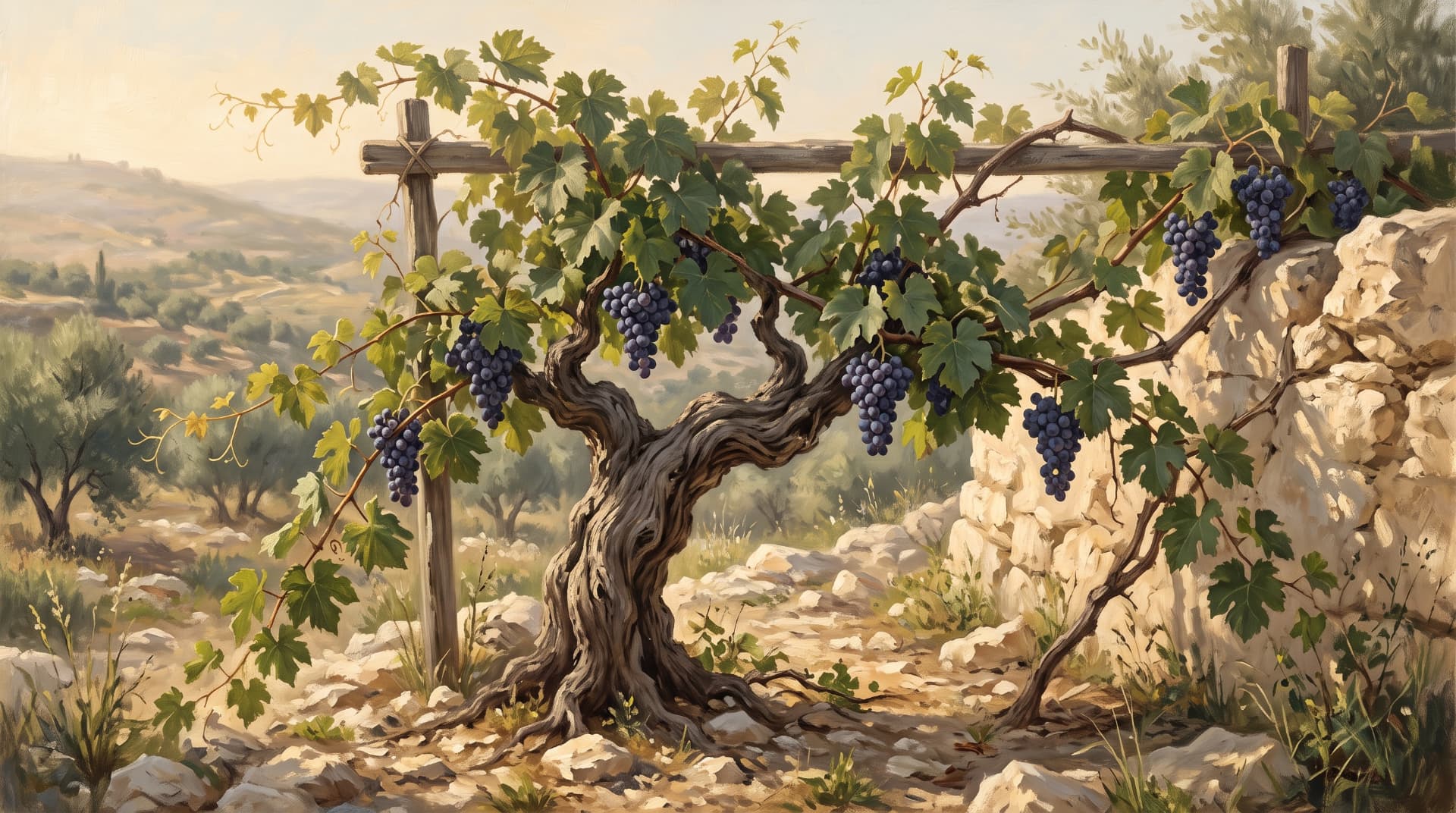
“I AM the true vine, and my Father is the husbandman.” — John 15:1 (KJV)
The Literary Setting of the Farewell Discourse
In John 15, Jesus addresses His disciples within the wider narrative setting of the Farewell Discourse (John 13–17). In this intimate gathering, sorrow, bewilderment, and the reality of His departure loom large. Jesus has washed the disciples’ feet, identified Judas as the betrayer, and announced that He will soon depart. Facing the prospect of Christ's physical absence, the disciples are troubled by how their communion with God and their ongoing mission will be sustained.
Jesus speaks directly to that uncertainty with the declaration: “I am the true vine.” This imagery reassures the disciples that His departure does not sever their relationship with God. Instead, spiritual life and vital communion with the Father are situated within Jesus Himself. The immediate literary context highlights union, relational continuity, and mutual indwelling as the foundation for the disciples’ future witness.
Israel as the Vineyard in the Hebrew Bible
The imagery of the vine was deeply familiar to Jesus’ Jewish listeners. Throughout the Hebrew Scriptures, the vine (gephen) and vineyard (kerem) frequently serve as emblems for Israel as God’s chosen covenant people.
- Psalm 80:8–16 recounts Israel’s redemptive history through this image: “Thou hast brought a vine out of Egypt: thou hast cast out the heathen, and planted it.” The psalmist laments, however, that this divinely planted vine was broken down, ravaged, and burned with fire.
- Isaiah 5:1–7 records the Song of the Vineyard, where YHWH fences, clears stones, and plants His vineyard with the choicest vine. Despite this care, it yields only wild grapes. Isaiah explicitly interprets the metaphor: “For the vineyard of the LORD of hosts is the house of Israel, and the men of Judah his pleasant plant” (v. 7).
- Jeremiah 2:21 delivers a similar prophetic lament: “Yet I had planted thee a noble vine, wholly a right seed: how then art thou turned into the degenerate plant of a strange vine unto me?”
- Ezekiel 15:1–8 emphasizes that vine wood inherently lacks utility for timber or craftsmanship; unlike forest trees, its wood is useful only as fuel for the fire.
While John 15 does not explicitly cite these Old Testament texts, their cumulative weight forms the historical and theological backdrop of the discourse. As a study observation, reading Jesus’ self-identification as the “true vine” against this national motif suggests He presents Himself as the genuine, faithful realization of what the covenant nation was planted to be before God.
Exegesis of John 15:1–3: The True Vine and the Vinedresser
The Greek adjective alēthinos can mean ‘true’ or ‘genuine.’ In John 15:1, Jesus identifies Himself as the true vine and His Father as the geōrgos—the vinedresser, farmer, or husbandman who tends the crop. This emphasizes divine oversight: God Himself tends and cultivates the vine.
In John 15:2, Jesus describes the twofold activity of the Father: He takes away every branch that does not bear fruit, and He prunes (kathairei) every branch that bears fruit so that it may bring forth more. The verb kathairō carries the dual sense of cleaning and pruning away unwanted growth.
Jesus connects this directly to His disciples through verbal wordplay in verse 3: “Now ye are clean [katharoi] through the word which I have spoken unto you.” The cleansing power of Christ’s word already marks the disciples, while the Father’s ongoing cultivation ensures that fruitful branches yield an even fuller harvest.
Abiding, Fruit, and the Warning of John 15:6
The core imperative of the passage appears in John 15:4: “Abide in me, and I in you. As the branch cannot bear fruit of itself, except it abide in the vine; no more can ye, except ye abide in me.”
In the Greek text of John 15:4–10, the verb menō (“abide,” “remain,” or “dwell”) occurs ten times, underscoring an enduring, dependent relationship. The passage portrays fruitfulness not as an autonomous human accomplishment, but as the natural outcome of remaining connected to Christ.
Alongside this instruction stands the solemn warning of John 15:6:
“If a man abide not in me, he is cast forth as a branch, and is withered; and men gather them, and cast them into the fire, and they are burned.”
Recalling the imagery of Ezekiel 15 regarding vine wood consigned to the flames, the text describes the severe outcome of separation from the vine: severed branches dry up, lose all vitality, and are gathered for the fire. The discourse underscores the incapacity of self-reliant effort, as Jesus states plainly in verse 5: “without me ye can do nothing.” Abiding remains essential for fruitful prayer, spiritual growth, and shared joy in fellowship with God (vv. 7–11).
Love, Obedience, and Covenant Friendship
In John 15:9–17, the botanical metaphor transitions into explicit ethical and relational instruction. Abiding in the vine is expressed as abiding in Christ’s love (v. 9), which is lived out through obedience to His commandments:
“If ye keep my commandments, ye shall abide in my love; even as I have kept my Father's commandments, and abide in his love.” — John 15:10
Obedience is presented not as a legalistic bid to earn favor, but as the ultimate expression of abiding in Christ’s love. Within this relationship, Jesus defines the disciples' standing not merely as servants (douloi), but as friends (philoi). The distinction turns on revelation: a servant does not know his master's business, whereas Jesus has made known to them everything He heard from the Father (v. 15).
This friendship rests on divine initiative: “Ye have not chosen me, but I have chosen you, and ordained you, that ye should go and bring forth fruit, and that your fruit should remain” (v. 16). The defining fruit commanded among the disciples is mutual, self-giving love that reflects Christ’s own sacrifice: “Greater love hath no man than this, that a man lay down his life for his friends” (v. 13).
Canonical Synthesis: Old Testament Background and John 15
| Passage | Old Testament Context | Connection to John 15 | Evidence Label |
|---|---|---|---|
| Psalm 80:8–19 | Israel depicted as a vine brought out of Egypt, broken down and burned. | Jesus presents Himself as the true, faithful vine. | Study Observation |
| Isaiah 5:1–7 | YHWH’s vineyard yielding wild grapes despite divine cultivation. | The Father as farmer tends the true vine to secure genuine fruit. | Study Observation |
| Jeremiah 2:21 | A choice vine degenerating into an alien plant. | Contrasts Israel's historic failure with Christ's fruitful reality. | Possible Echo |
| Ezekiel 15:1–8 | Vine wood deemed useless for timber and consigned to the fire. | Warns of non-abiding branches being gathered and burned. | Possible Echo |
| John 15:1–17 | Farewell Discourse on mutual indwelling, obedience, and mission. | Primary exposition of abiding, pruning, and lasting fruit. | Direct Statement |
Conclusion
Jesus' proclamation, “I am the true vine,” draws upon Israel’s rich covenantal imagery. Where the historic vineyard repeatedly faltered into unfruitfulness, Jesus presents Himself as the genuine vine through whom life and lasting fruit emerge.
John 15 anchors discipleship in continuous, organic dependence upon Christ. Vitality, fruitful prayer, and covenant friendship with God flow from remaining attached to Him, expressing His life through obedience and self-giving love toward one another.
The vine is one thread in a wider biblical pattern. Follow its strands across Scripture in No Other Beside Me—and see where they converge.