Divine Presence, Wilderness Provision, and the Identity of Israel’s God
“And all drank the same spiritual drink, for they were drinking from a spiritual rock which followed them; and the rock was Christ.”
— 1 Corinthians 10:4 NASB
The Wilderness Crisis: Thirst and Divine Presence at Rephidim
The journey of the sons of Israel through the wilderness of Sin to Rephidim is marked by a crisis that is fundamentally theological rather than merely physical. When the congregation found no water to drink, their complaint against Moses quickly escalated into a challenge directed at the LORD himself: “Why have you brought us up from Egypt, to kill us and our children and our livestock with thirst?” (Exod 17:3 NASB). This murmur was not a simple request for sustenance. It was an interrogation of the divine covenant.
The naming of the place as Massah, meaning testing, and Meribah, meaning quarreling, preserves the memory of this rebellion, “because they put the LORD to the test, saying, ‘Is the LORD among us, or not?’” (Exod 17:7 NASB). The central issue is therefore the presence of Israel’s God among his people.
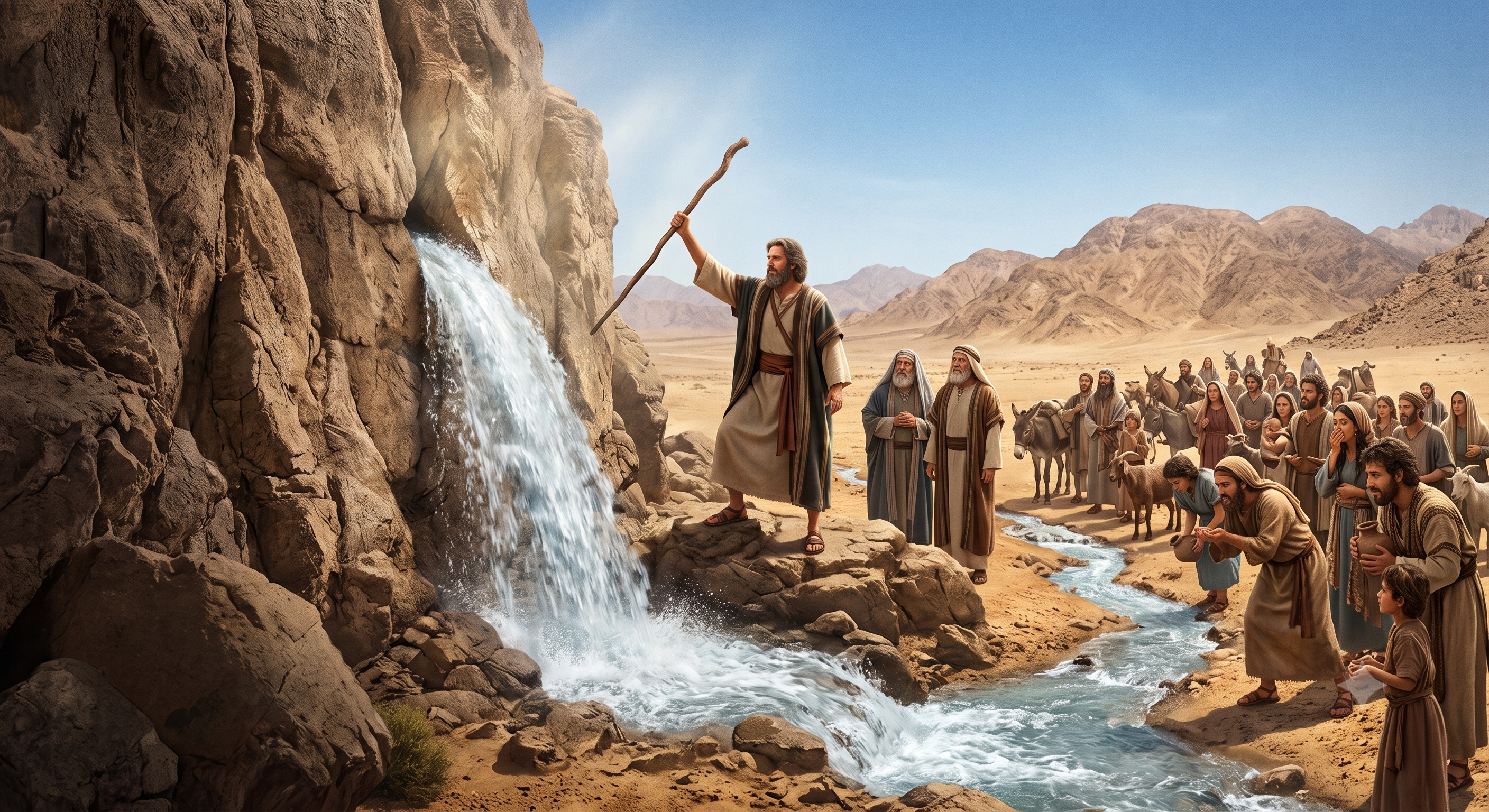
In response to Moses’s cry, the LORD gives a remarkable promise: “Behold, I will stand before you there on the rock at Horeb; and you shall strike the rock, and water will come out of it, so that the people may drink” (Exod 17:6 NASB). YHWH promises to stand before Moses on or at the rock. The rock becomes the appointed site of his life-giving action, and the flowing water is mediated through Moses’s obedient act. At the place where Israel questions whether YHWH is among them, he answers through sustaining power.
Exodus 17 narrates the historical event in which YHWH stands at the rock and provides water for Israel. Paul’s later declaration in 1 Corinthians 10 does not erase this historical meaning. It interprets the event within a wider canonical and Christological horizon.
The Covenant Designation: YHWH as the Rock in Deuteronomy 32
As the Pentateuch draws to a close, the physical rock of the wilderness journey gives way to a major covenant designation for YHWH. In the Song of Moses, “the Rock” is used repeatedly as a title for Israel’s God, representing his stability, faithfulness, justice, and generative care. Moses proclaims, “The Rock! His work is perfect, for all His ways are just; a God of faithfulness and without injustice, righteous and upright is He” (Deut 32:4 NASB). Here, the title represents the unchanging character of YHWH in contrast to Israel’s persistent unfaithfulness.
The Song later warns the nation against apostasy, declaring, “You neglected the Rock who begot you, and forgot the God who gave you birth” (Deut 32:18 NASB). By placing generative imagery alongside the title, Moses presents YHWH as the source of Israel’s existence. He is not merely a defensive refuge. He is the covenant God from whom Israel’s life and identity proceed.
This designation also carries a sharp polemical edge. Moses contrasts the true God of Israel with the powers trusted by the surrounding nations: “For their rock is not as our Rock, even our enemies themselves judge this” (Deut 32:31 NASB). Rock imagery could therefore be applied to rival objects of trust, but no rival is comparable to YHWH.
Within Deuteronomy 32, then, “the Rock” is more than a generic metaphor for strength. It identifies YHWH as Israel’s faithful creator, judge, refuge, and source of life. This established scriptural usage gives Paul’s later declaration that “the rock was Christ” its theological weight.
Mediated Provision and Divine Holiness: Exodus 17 and Numbers 20
The canonical narrative presents a second and distinct wilderness water crisis at Kadesh in Numbers 20. This event must be distinguished from the earlier incident at Rephidim. In Exodus 17, Moses is commanded to strike the rock. In Numbers 20, the LORD commands him, “Take the staff and assemble the congregation, you and your brother Aaron, and speak to the rock before their eyes, that it will yield its water” (Num 20:8 NASB).
Moses instead strikes the rock twice and says, “Listen now, you rebels; shall we bring forth water for you from this rock?” (Num 20:10 NASB). Water still comes forth abundantly, but the provision does not excuse Moses’s disobedience. The LORD states the reason for his judgment directly: “Because you did not trust in Me, to treat Me as holy in the sight of the sons of Israel, therefore you shall not bring this assembly into the land which I have given them” (Num 20:12 NASB).
The text’s explicit explanation must govern the interpretation. Moses did not trust YHWH and did not treat him as holy before Israel. A further inference may cautiously be drawn from Moses’s question, “shall we bring forth water.” His wording may have obscured the singular agency of YHWH by placing Moses and Aaron too prominently within the act of provision. This inference should not replace the explanation given in verse 12, nor should it be turned into certainty about Moses’s internal motives.
The provision remained an act of the LORD. Moses and Aaron served as appointed mediators, but the power belonged to YHWH alone. The contrast between Exodus 17 and Numbers 20 therefore reinforces the distinction between divine agency and human mediation.
The Rock of Salvation and Refuge: Psalms and Isaiah
The identification of YHWH as Israel’s Rock continues throughout the Psalms and the prophets. Psalm 78 recounts the wilderness rebellion and the LORD’s sustaining mercy: “He split the rocks in the wilderness and gave them plenty to drink like the ocean depths. He brought forth streams from the rock and made waters run down like rivers” (Ps 78:15–16 NASB). The water from the rock becomes part of Israel’s remembered testimony concerning the power and patience of God.
Psalm 95 opens with a call to worship: “Come, let’s sing for joy to the LORD, let’s shout joyfully to the rock of our salvation” (Ps 95:1 NASB). The same psalm recalls Meribah and Massah: “Today, if you will hear His voice, do not harden your hearts as at Meribah, as on the day of Massah in the wilderness” (Ps 95:7–8 NASB). The Rock whom Israel is summoned to worship is thus the LORD whom the wilderness generation tested.
Isaiah preserves different uses of the imagery. In Isaiah 33:16, “the impregnable rock” describes the secure refuge of the righteous rather than functioning unambiguously as a direct divine title. The security remains a provision of YHWH, but the immediate expression concerns the place of protection.
In Isaiah 44:8, by contrast, YHWH claims the designation directly: “Is there any God besides Me, or is there any other Rock? I know of none” (NASB). The rhetorical question reinforces the incomparable identity of Israel’s God. Isaiah 26:4 likewise exhorts the people, “Trust in the LORD forever, for in GOD the LORD, we have an everlasting Rock” (NASB).
Across these texts, the imagery establishes YHWH as Israel’s incomparable source of refuge, stability, and salvation. This scriptural background becomes especially significant when Paul identifies Christ with the Rock of Israel’s wilderness experience.
Pastoral Warning and Spiritual Provision: The Context of 1 Corinthians 10
Against this background, Paul addresses the Corinthian church in 1 Corinthians 10. His immediate purpose is pastoral and admonitory. He warns believers against idolatry, sexual immorality, testing the Lord, and presumption by drawing direct parallels with Israel’s failures in the wilderness. Participation in covenantal privileges does not make rebellion harmless.
Paul reminds the Corinthians that “our fathers were all under the cloud and all passed through the sea; and all were baptized into Moses in the cloud and in the sea; and all ate the same spiritual food; and all drank the same spiritual drink” (1 Cor 10:1–4 NASB). The repeated word “all” intensifies the warning. The entire wilderness generation participated in remarkable acts of divine provision, yet many fell under judgment because they turned from the God who sustained them.
Paul’s use of the adjective “spiritual” does not mean that the manna and water were nonphysical or immaterial. They were real provisions that sustained physical life. Within his argument, the term presents them as gifts characterized by divine agency and interpreted through the theological reality he now discloses.
Israel’s experiences “happened to them as an example” and “were written for our instruction” (1 Cor 10:11 NASB). Paul is not abandoning history for allegory. He reads Israel’s historical experience as a divinely ordered pattern whose significance reaches the Corinthian believers.
The Accompanying Rock and the Christological Identification
Paul then makes his central and striking assertion: “for they were drinking from a spiritual rock which followed them; and the rock was Christ” (1 Cor 10:4 NASB). The Greek participle translated “followed” agrees grammatically with “rock” and may carry the sense of following or accompanying. The imperfect verb in the preceding clause describes Israel as repeatedly drinking from this provision.
The language does not require the conclusion that a physical stone rolled through the wilderness. Nor does the participle alone settle whether Paul is describing personal accompaniment by the preexistent Christ, a continuing source of divine provision, a typological or sacramental reality, or some combination of these ideas. The theological force lies in Paul’s complete declaration: “the rock was Christ.”
Interpreters have consequently approached the statement in different ways. Some understand Paul to mean that the preexistent Christ personally accompanied Israel. Others emphasize typological or sacramental identification, while still others focus upon the continuing divine provision that sustained Israel throughout its journey. These readings need not all be treated as mutually exclusive, and none requires belief that a literal physical rock travelled behind the congregation.
Within the present canonical reading, Paul’s statement constitutes a strong typological and Christological identification. Against the scriptural testimony concerning YHWH as Israel’s covenant Rock and wilderness provider, the declaration carries substantial divine-identity significance. Christ is drawn into the identity and saving action already attributed to Israel’s God, rather than appearing as an unrelated actor within the Exodus.
The Textual Variant in 1 Corinthians 10:9
The immediate context may provide further support, although it must be handled with textual restraint. In 1 Corinthians 10:9, the manuscript tradition preserves readings corresponding to “Christ,” “the Lord,” and “God.” Many modern critical editions print “Christ,” while the NASB cited here follows the reading “the Lord.”
The difference is significant for textual criticism, but the article’s argument does not depend upon resolving it. If “Christ” is original, Paul warns the Corinthians not to test Christ as members of the wilderness generation did. If “the Lord” is read, the warning still belongs to Paul’s larger comparison between Israel and the church. In either case, 1 Corinthians 10:4 remains the primary basis for the present argument because its Christological identification is explicit.
The Stone of Stumbling and the Single Subject of Revelation
Paul’s language belongs to a wider New Testament appropriation of scriptural stone and rock imagery. In Isaiah 8:13–14, the LORD of armies is the one who becomes “a sanctuary” and “a stone to strike and a rock to stumble over” for the houses of Israel (NASB). The same divine presence becomes sanctuary to those who regard YHWH as holy and an occasion of stumbling to those who resist him.
In Romans 9:32–33, Paul places language from Isaiah 8:14 together with the cornerstone promise of Isaiah 28:16. He writes, “Behold, I am laying in Zion a stone of stumbling and a rock of offense, and the one who believes in Him will not be put to shame” (NASB). Paul does not reproduce either Isaiah passage in isolation. He joins their language within his argument concerning Israel’s pursuit of righteousness and its stumbling over Christ.
First Peter 2:4–8 develops the same scriptural trajectory. Christ is presented as the living stone rejected by people but chosen and precious before God. Believers are described as living stones being built into a spiritual house. The passage applies Isaiah 28:16 to Christ as the chosen cornerstone and Isaiah 8:14 to Christ as the stone of stumbling and rock of offense.
These texts extend the significance of 1 Corinthians 10:4 beyond a single metaphor. Images and saving functions associated with YHWH in Israel’s Scriptures converge upon Christ in apostolic interpretation. This does not make every Old Testament reference to a stone or rock an explicit prediction of Jesus, nor does it permit the historical meaning of those passages to be bypassed. Rather, the New Testament places Christ within the scriptural identity and saving action of Israel’s God.
The emphasis therefore falls on continuity rather than an additional divine identity. The God whose presence sustained Israel at Horeb is disclosed Christologically as the spiritual Rock from whom Israel drank and as the stone upon whom faith rests or unbelief stumbles.
Conclusion
Paul’s declaration that “the rock was Christ” stands within a canonical pattern already established by Israel’s Scriptures. The wilderness narratives identify YHWH as the giver of water, while Deuteronomy, the Psalms, and Isaiah develop Rock imagery around his faithfulness, refuge, life, and salvation.
Against this background, 1 Corinthians 10:4 carries considerable theological force. Paul places Christ within the scriptural identity and saving action of the God who sustained Israel in the wilderness. The historical Exodus is not displaced, and YHWH is not replaced by another divine actor. Rather, Israel’s saving history is reread Christologically.
This identification forms one expression of the broader canonical pattern explored in No Other Beside Me: The Disclosure of the Single Subject. The New Testament identifies Jesus through names, images, works, and divine prerogatives rooted in the scriptural identity of YHWH. In 1 Corinthians 10:4, that disclosure appears with remarkable directness: “the rock was Christ.”