Exodus 34, Mark 2, and the Sovereign Prerogative of Absolution
“The LORD, the LORD, a God merciful and gracious, slow to anger, and abounding in steadfast love and faithfulness, keeping steadfast love for thousands, forgiving iniquity and transgression and sin...”
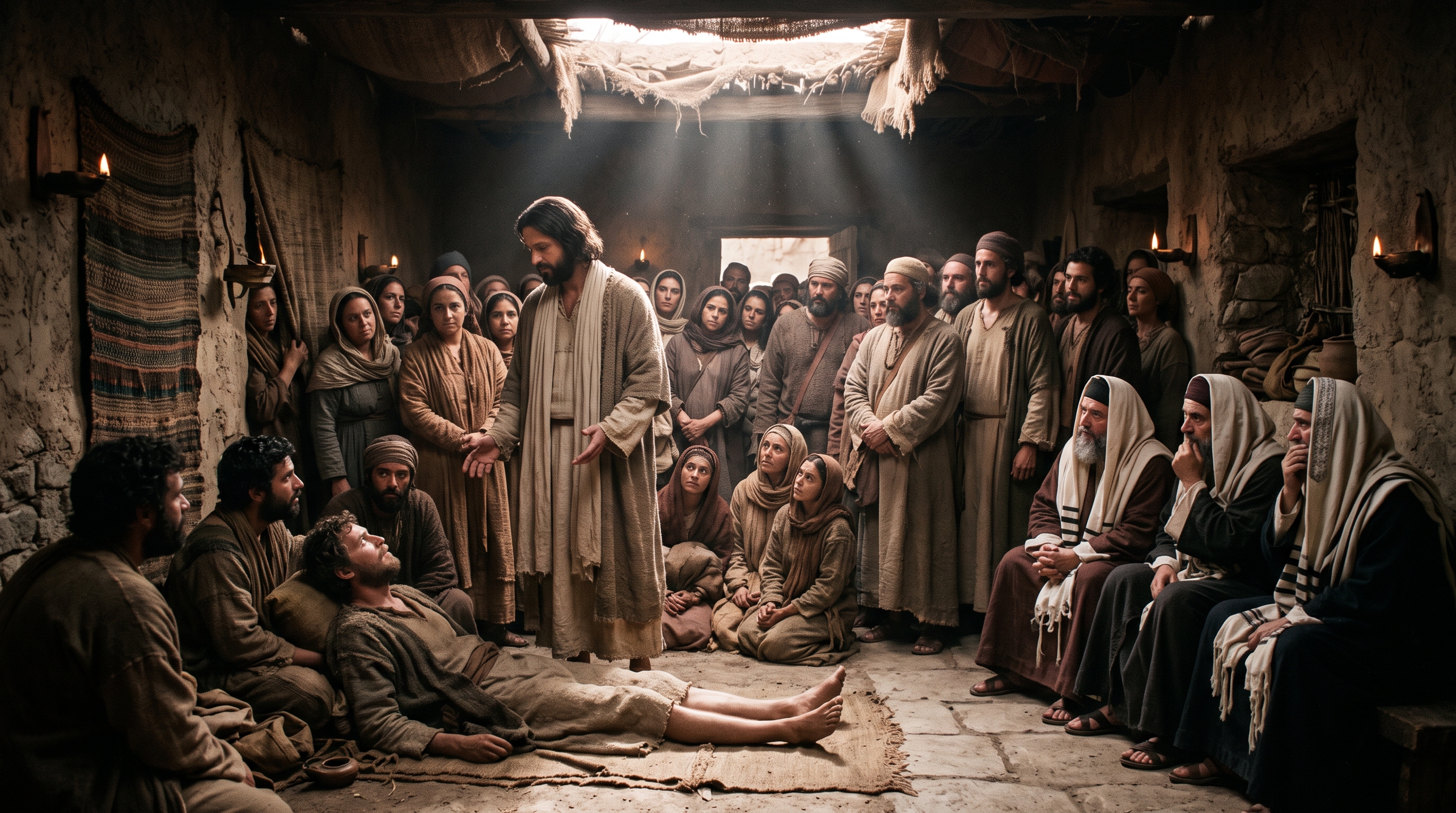
The controversy in Mark 2 begins with words spoken to a man whose visible condition seems to demand something else. Four men have carried a paralytic to Jesus, opened the roof above Him, and lowered their companion into the crowded house. Everything about the scene directs attention toward the man’s body, yet Jesus first addresses what no observer can see: “Son, your sins are forgiven.”
The scribes immediately recognize a theological problem. “Why does this man speak like that? He is blaspheming! Who can forgive sins but God alone?” (Mark 2:5–7).
Their objection reaches far beyond the room in Capernaum. Israel’s Scriptures had long spoken of forgiveness within the revelation of YHWH Himself, while also providing recognizable forms through which forgiveness could be mediated or announced. Priests made atonement. Prophets declared what YHWH had done. Mark places Jesus within that scriptural world and allows the scribes themselves to formulate the difficulty created by His words. The question is therefore not simply whether Jesus possesses unusual spiritual authority, but what is being claimed when the Son of Man exercises authority on earth to forgive sins.
The God Who Forgives Iniquity
The background begins with one of Israel’s greatest acts of covenant rebellion. While Moses remains on Sinai, Israel makes the golden calf and directs worship toward an image. The people who had recently entered covenant with YHWH violate it almost immediately. Moses intercedes for them and even pleads, “If you will forgive their sin, but if not, please blot me out of your book that you have written” (Exod 32:32). The crisis concerns more than the breaking of a commandment. Israel has rebelled against the God who delivered them from Egypt, and the question of forgiveness now stands within the threatened continuation of the covenant itself.
The answer reaches its extraordinary climax in Exodus 34. YHWH descends in the cloud, passes before Moses, and proclaims His own name: “The LORD, the LORD, a God merciful and gracious, slow to anger, and abounding in steadfast love and faithfulness... forgiving iniquity and transgression and sin.” Forgiveness appears here within divine self-disclosure. Israel is not simply told that guilt may be removed. In the aftermath of covenant rupture, it learns something about the identity and character of the God against whom it has rebelled.
The expression translated “forgiving iniquity” uses nāśāʾ, a verb whose semantic range includes lifting, carrying, and bearing. The proclamation gathers “iniquity and transgression and sin” into an unusually comprehensive description of human guilt, while the continuation of the verse preserves the reality of judgment: YHWH “will by no means clear the guilty” (Exod 34:7). Mercy and judgment therefore stand within the same proclamation. The God who judges Israel’s rebellion identifies Himself as the God who forgives it. Forgiveness has entered Israel’s theology not merely as something YHWH does, but as part of His proclamation of who He is.
“I, I Am He”
Isaiah approaches the matter from another angle. The prophet addresses a people who have burdened YHWH with their sins and wearied Him with their iniquities (Isa 43:24). Against that accusation comes an unexpected declaration: “I, I am he who blots out your transgressions for my own sake, and I will not remember your sins” (Isa 43:25). The repeated pronoun concentrates attention upon the actor. The One who names Israel’s offenses also identifies Himself as the One who removes them.
The significance lies not simply in another affirmation that God forgives. Isaiah places the offended party and the forgiving subject in the same speaker. YHWH does not describe forgiveness from a distance; He claims the blotting out of Israel’s transgressions as His own action. The Psalms preserve the same orientation. Psalm 103 blesses YHWH as the One “who forgives all your iniquity,” while Psalm 130 places the worshiper directly before Him: “If you, O LORD, should mark iniquities, O Lord, who could stand? But with you there is forgiveness” (Ps 103:3; 130:3–4). Exodus has located forgiveness within YHWH’s proclaimed character. Isaiah and the Psalms bring the agency of forgiveness into the foreground.
Priests, Prophets, and the Language of Mediation
Israel’s Scriptures nevertheless do not reserve every statement concerning forgiveness to direct divine speech. Priests and prophets participate genuinely in the process, and the manner in which Scripture describes their participation provides an important distinction for reading Mark. Leviticus repeatedly describes the priest making atonement for an offender, after which “he shall be forgiven” (Lev 4:20, 26, 31, 35). The priest performs a divinely appointed covenantal function, but the language distinguishes his act of making atonement from the forgiveness that follows.
The prophetic pattern makes the distinction still clearer. When David confesses his sin concerning Bathsheba and Uriah, Nathan answers, “The LORD also has put away your sin; you shall not die” (2 Sam 12:13). Nathan speaks with genuine prophetic authority, but his declaration identifies YHWH as the subject of the act. He does not say, “I have put away your sin.” He announces what YHWH has done.
Scripture therefore already possesses categories for human beings who stand before sinners with genuine divine authorization. This matters because the mere fact that Jesus speaks about forgiveness cannot by itself establish what kind of authority Mark intends the reader to perceive. The more precise question is whether Jesus remains within the familiar grammar of mediation or whether the narrative places a different kind of claim upon His lips.
“Who Can Forgive Sins but God Alone?”
The paralytic lies before Jesus, and Jesus tells him, “Son, your sins are forgiven.” At first, the form of the saying leaves room for a familiar possibility. The passive expression could be heard as an announcement that God has forgiven the man, much as a prophet might declare a divine decision. Read in isolation, the saying does not yet resolve the issue raised by the scribes. Mark, however, does not leave it in isolation.
Jesus answers their objection by asking, “Which is easier, to say to the paralytic, ‘Your sins are forgiven,’ or to say, ‘Rise, take up your bed and walk’?” (Mark 2:9). The contrast exposes a problem of verification. A declaration concerning forgiveness refers to a reality no observer in the house can see. The command to rise, by contrast, can be tested immediately. Jesus therefore joins the invisible claim to a visible act: “But that you may know that the Son of Man has authority on earth to forgive sins...” (Mark 2:10). He then commands the paralytic to rise, take up his bed, and go home, and the man does so.
The miracle consequently performs an evidentiary function within the controversy. Jesus Himself introduces it with the words “that you may know.” The healing is not merely a second display of power appended to the pronouncement of forgiveness. It renders His claim to invisible authority publicly contestable. Those in the house cannot see sins being forgiven, but they can see the paralytic rise. Mark binds the two together so that the visible act bears witness to the authority claimed in the invisible one.
Authority on Earth
The wording of that claim now deserves attention. The Son of Man possesses exousia, “authority,” on earth to forgive sins. Whatever ambiguity might have remained in the passive declaration “your sins are forgiven,” Jesus now speaks explicitly about an authority possessed by the Son of Man. The narrative has moved from a pronouncement that might conceivably be heard as prophetic declaration to a direct claim concerning who possesses authority over forgiveness.
The phrase “on earth” gives the claim a further dimension. Jesus is not speaking within the Jerusalem sanctuary, nor does Mark narrate a sacrifice, priestly intervention, or prophetic formula before the paralytic receives the word of forgiveness. The controversy unfolds in an ordinary house in Capernaum. This does not negate the place of Israel’s sacrificial institutions within their covenantal setting. It does, however, sharpen the scene Mark has constructed: the authority under dispute is being exercised immediately in the presence of Jesus.
The paralytic rises, takes up his bed, and walks before them all. The crowd responds by glorifying God and declaring, “We never saw anything like this!” (Mark 2:12). Their astonishment belongs to more than the recovery of a disabled man. The healing has been deliberately framed by a controversy concerning sin, forgiveness, and the authority of the Son of Man. The restored body is what everyone sees; the authority it vindicates is what the narrative has asked them to consider.
Who, Then, Is This?
The movement from Sinai to Capernaum brings the question into focus. At Sinai, YHWH proclaims His name as the One “forgiving iniquity and transgression and sin.” In Isaiah, He declares, “I, I am he who blots out your transgressions.” Israel also knew the forms through which forgiveness could be mediated: priests made atonement, while prophets such as Nathan announced what YHWH had done. Those texts establish the scriptural world within which the scribes’ objection becomes intelligible.
Mark then places Jesus before the paralytic. The scribes ask, “Who can forgive sins but God alone?” Jesus does not answer by disputing their premise. Nor does His response simply repeat the familiar prophetic formula by attributing the act to YHWH. Instead, He declares that the Son of Man has “authority on earth to forgive sins,” and He performs the healing so that those present “may know” that the authority He claims is real.
Mark does not interrupt the narrative to resolve the theological implications of the scene. He allows the relationship between Israel’s Scriptures, the scribes’ objection, Jesus’ claim, and the visible sign to generate the question.
Israel already knew who forgives iniquity. Now, in a house at Capernaum, Jesus speaks forgiveness, claims authority over it, and vindicates that claim before those who had asked who could possibly possess such a prerogative.
Who, then, is this?
That question lies at the heart of No Other Beside Me: The Disclosure of the Single Subject, where the biblical identity of the One revealed in Christ is pursued across the wider scriptural witness.