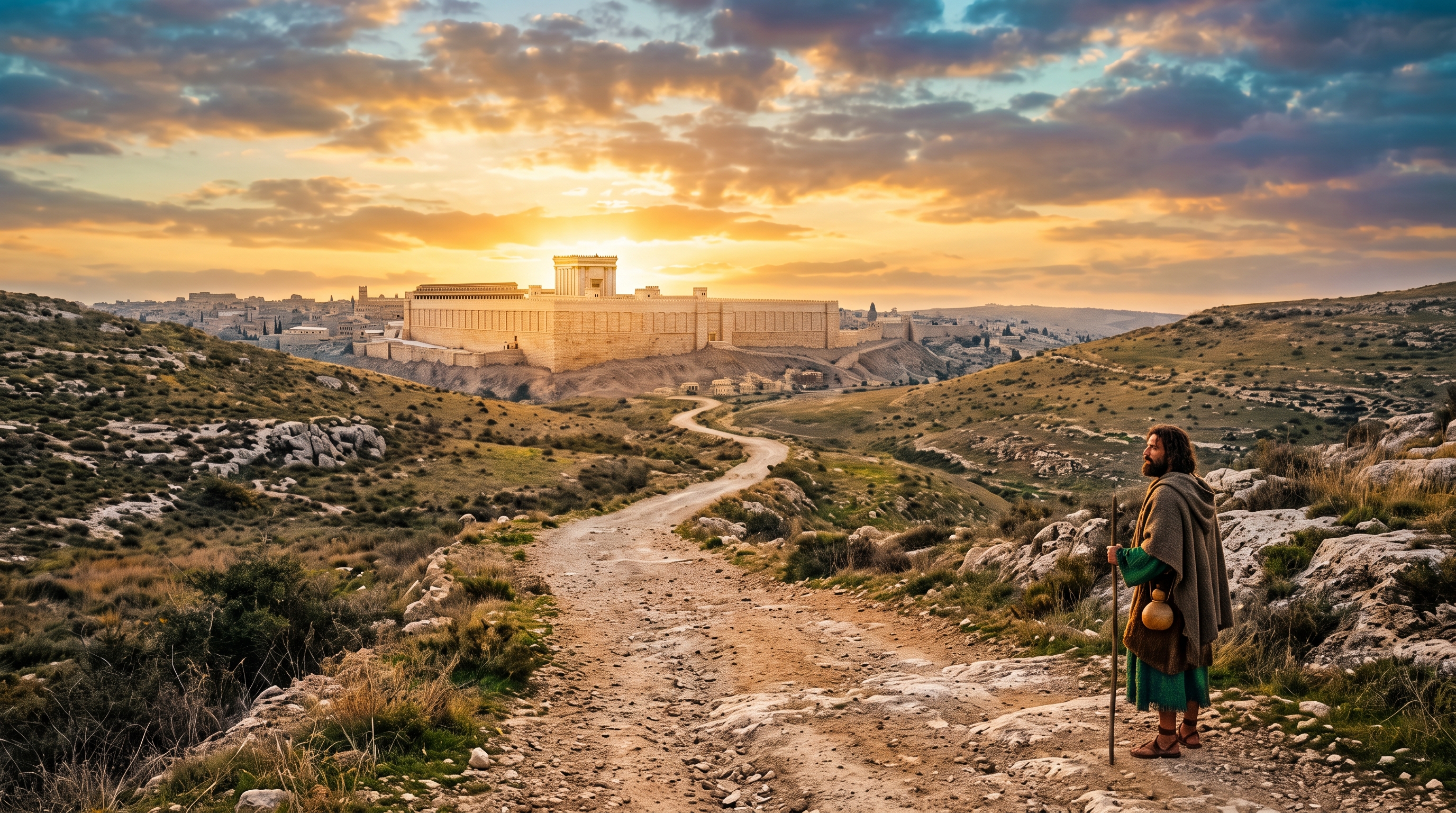
Malachi 3:1 and the Arrival of Jesus
“Behold, I send my messenger, and he will prepare the way before me. And the Lord whom you seek will suddenly come to his temple.”
At the opening of Mark’s Gospel, John the Baptist appears in the wilderness announcing that someone greater is coming after him. The scene is familiar, but the Scriptures Mark places over it are easily passed by. One speaks of a messenger sent ahead to prepare the way, while the other calls for a road to be prepared in the wilderness for the coming of YHWH.
The first comes from Malachi, where the expectation is particularly direct: YHWH declares that He will send a messenger to prepare the way “before me,” after which “the Lord whom you seek will suddenly come to his temple” (Mal 3:1). Why must the Lord come to His temple? Who is the messenger sent before Him? And what happens when the Gospels identify that messenger as John the Baptist, while the one whose arrival follows him is Jesus?
When the Glory Departed
The language of divine coming already carried a history by the time Malachi spoke. Ezekiel had witnessed the judgment of Jerusalem through a vision in which the glory of YHWH withdrew from the sanctuary (Ezek 10:18–19; 11:22–23). The departure belongs to Ezekiel’s larger indictment of a sanctuary corrupted by the people among whom YHWH had placed His name (Ezek 8:5–18).
Ezekiel’s later vision of restoration reverses the movement. In Ezekiel 43, the prophet sees the glory of the God of Israel approaching from the east. It enters the visionary temple through the eastern gate and fills the house (Ezek 43:1–5). YHWH declares, “This is the place of my throne and the place of the soles of my feet, where I will dwell in the midst of the people of Israel forever” (Ezek 43:7). Departure had accompanied judgment; restoration was envisioned in terms of return and renewed dwelling.
The restoration after the exile should not be described as though God were simply absent from the rebuilt sanctuary or from His people. Haggai explicitly assures the restored community, “My Spirit remains in your midst” (Hag 2:5). Yet Scripture records no visible theophanic return corresponding to Ezekiel’s vision of the glory entering and filling the house. The prophetic expectation of divine coming and surpassing glory therefore remained alive.
Haggai looks toward a greater glory for the house (Hag 2:6–9), while Zechariah announces, “Sing and rejoice, O daughter of Zion, for behold, I come and I will dwell in your midst, declares the LORD” (Zech 2:10). The temple had been rebuilt and YHWH remained present with His people, but the anticipated manifestation of divine coming still lay ahead. Against this prophetic background, Malachi speaks.
“Where Is the God of Justice?”
Malachi 3:1 answers a question raised in the preceding verse. The people have wearied YHWH by questioning the moral order of the covenant. They complain that those who do evil prosper and then ask, “Where is the God of justice?” (Mal 2:17). YHWH answers, “Behold, I send my messenger, and he will prepare the way before me.” The direction of the preparation matters. The Hebrew lepanai, “before me,” leaves the divine speaker as the one before whom the way is being prepared. The messenger is sent ahead because an arrival is approaching.
The passage continues: “And the Lord whom you seek will suddenly come to his temple; and the messenger of the covenant in whom you delight, behold, he is coming, says the LORD of hosts” (Mal 3:1). The coming figure is designated hāʾādôn, “the Lord,” a designation used elsewhere of YHWH, and the sanctuary is described as “his temple.” The precise relationship between “the Lord” and “the messenger of the covenant” has invited different interpretations, and Malachi’s compressed language does not require that question to be resolved here. The movement of the passage itself is sufficient for the present argument: YHWH announces a messenger who will prepare the way before Him, followed by the coming of the Lord to His temple. The people have asked where the God of justice is; Malachi answers by announcing His coming.
Who Can Endure His Coming?
The people may seek the Lord, but Malachi immediately questions whether they understand what His arrival entails: “But who can endure the day of his coming, and who can stand when he appears?” (Mal 3:2). The imagery turns to purification. The coming one is “like a refiner’s fire and like fullers’ soap.” He sits as a refiner and purifier of silver, cleansing the sons of Levi so that they may once again present offerings to YHWH in righteousness (Mal 3:2–4).
This directly addresses the priestly corruption exposed earlier in the book. Malachi had accused the priests of despising YHWH’s name and polluting His altar through unacceptable offerings (Mal 1:6–14). The promised coming to the temple therefore concerns the worship taking place there. The one who comes does not merely enter the sanctuary; His coming exposes and purifies. The judgment then extends beyond the priesthood. “Then I will draw near to you for judgment,” YHWH declares, naming sorcery, adultery, false oaths, oppression of workers, injustice toward widows and orphans, and mistreatment of the sojourner (Mal 3:5). Corrupted worship and corrupted covenant life belong to the same crisis. The promised arrival is therefore a visitation of purification and judgment. Malachi, however, places another figure before it: the messenger.
The Messenger Before the Coming
Malachi returns to the promise of a forerunner at the conclusion of the book: “Behold, I will send you Elijah the prophet before the great and awesome day of the LORD comes” (Mal 4:5). The promised Elijah is sent before divine visitation, and his ministry turns hearts in preparation for the approaching day of YHWH (Mal 4:5–6).
The New Testament places John the Baptist within this expectation from the beginning. Before John is born, the angel tells Zechariah that his son will turn many of Israel’s children “to the Lord their God” and will go before Him “in the spirit and power of Elijah,” turning hearts and preparing “for the Lord a people made ready” (Luke 1:16–17). The language recalls Malachi’s closing promise.
The connection becomes explicit when Jesus speaks about John: “This is he of whom it is written, ‘Behold, I send my messenger before your face, who will prepare your way before you’” (Matt 11:10; cf. Luke 7:27). The identification of John with the messenger of Malachi 3:1 is therefore not a speculative inference by modern readers. The Gospel tradition makes the connection explicitly. This matters because Malachi has already established the function of that messenger: he appears before the coming.
“He Will Prepare Your Way”
Mark places this prophetic framework at the threshold of his Gospel: “Behold, I send my messenger before your face, who will prepare your way, the voice of one crying in the wilderness: ‘Prepare the way of the Lord, make his paths straight’” (Mark 1:2–3). The opening line draws upon Malachi 3:1, with wording that also recalls Exodus 23:20, while the second comes from Isaiah 40:3. Mark places them together before introducing John.
Isaiah’s contribution is important. Isaiah 40 announces comfort to a people whose exile is ending: “A voice cries: ‘In the wilderness prepare the way of the LORD; make straight in the desert a highway for our God’” (Isa 40:3). The one for whom the highway is prepared is not left unidentified. A few verses later comes the proclamation, “Behold your God!” followed by the announcement, “Behold, the Lord GOD comes with might” (Isa 40:9–10). The wilderness voice prepares Israel for the coming of YHWH.
Malachi presents a related pattern: YHWH sends His messenger to prepare the way “before me,” after which the Lord comes to His temple. Mark brings these prophetic voices together and places John within their expectation.
There is also an important grammatical feature in the form of the messenger prophecy Mark uses. Malachi has YHWH say that the messenger will prepare the way “before me,” whereas Mark reads, “I send my messenger before your face, who will prepare your way.” The wording stands close to both Malachi 3:1 and Exodus 23:20, so the second-person formulation cannot simply be attributed to an independent alteration of Malachi by Mark. What matters is the form in which the prophecy now stands at the beginning of the Gospel: the divine speaker addresses someone whose way the messenger will prepare.
John then appears in the wilderness, baptizing and preaching repentance, but his proclamation points beyond himself: “After me comes he who is mightier than I” (Mark 1:7). Two verses later Mark identifies the one who comes: “In those days Jesus came from Nazareth of Galilee” (Mark 1:9). The prophetic hope has now become a narrative sequence. The question is no longer merely whether John fulfills the role of the messenger, but whose way John has prepared.
The Lord Whom You Seek
Mark does not move directly from the Jordan to Jerusalem. Jesus’ ministry unfolds before the Gospel finally brings Him to the city and its sanctuary. Malachi should not be made into a hidden script governing every stage of that journey. Yet after Mark has opened his Gospel with Malachi’s messenger prophecy, Jesus’ eventual arrival at the temple deserves attention.
Near the end of His public ministry, Jesus enters Jerusalem and goes into the temple. Mark records an unusual detail: Jesus “looked around at everything,” and because the hour was late, He withdrew to Bethany with the Twelve (Mark 11:11).
The following day Jesus returns to the temple courts and begins driving out those buying and selling. He overturns the tables of the money changers and the seats of those selling pigeons and prevents merchandise from being carried through the temple (Mark 11:15–16). He interprets His action through Isaiah and Jeremiah: “Is it not written, ‘My house shall be called a house of prayer for all the nations’? But you have made it a den of robbers” (Mark 11:17; cf. Isa 56:7; Jer 7:11). The immediate scriptural interpretation of the action therefore comes from Isaiah and Jeremiah, not from an explicit citation of Malachi.
Yet the earlier use of Malachi makes the later scene difficult to overlook. Malachi had spoken of the Lord coming to His temple in a context of purification and judgment. Mark has already used the messenger prophecy to frame the arrival of Jesus. He now brings Jesus into the temple, where He examines its condition, confronts its practices, and later announces its destruction: “There will not be left here one stone upon another that will not be thrown down” (Mark 13:2). Within the scriptural framework established at the beginning of the Gospel, the correspondence invites the texts to be read together.
Whose Coming Has Mark Narrated?
An agency reading of these texts deserves serious consideration. Scripture knows commissioned representatives through whom God speaks and acts. John may therefore be understood as the prophetic messenger and Jesus as YHWH’s appointed Messiah, so that preparation for the Messiah serves the larger purpose of preparing Israel for the action of God. The existence of divine agency is not in dispute. The more specific question is whether agency alone adequately accounts for the particular Scriptures Mark has chosen to frame the arrival of Jesus.
Malachi’s messenger prepares the way before YHWH. Isaiah’s wilderness voice prepares “the way of the LORD,” a highway for “our God.” The Gospel tradition explicitly identifies John with Malachi’s messenger, and Mark brings these prophetic expectations together at the beginning of Jesus’ story. The one whose arrival follows John is Jesus.
Mark has therefore done more than place Jesus somewhere within Israel’s general expectation of divine salvation. He has taken texts whose announced subject is the coming of YHWH and made them the scriptural horizon within which the coming of Jesus is narrated. The later temple scene deepens that connection, but the fundamental textual problem has already been created at the Gospel’s opening.
Mark never pauses to translate this scriptural configuration into an abstract account of divine identity. He allows the architecture of Israel’s Scriptures and the movement of his narrative to carry the theological weight. Malachi said the messenger would prepare the way before YHWH. Jesus said John was that messenger. Mark then tells the story of the one who came after him.
The question of identity is left inside the narrative itself.
For a fuller exploration of how these scriptural patterns converge in the identity of Christ, see No Other Beside Me: The Disclosure of the Single Subject.