"Ye see then how that by works a man is justified, and not by faith only." — James 2:24
"...but faith which worketh by love." — Galatians 5:6b
Abstract
Within biblical theology, the relationship between the Pauline epistles and the Epistle of James forms a central interpretive tension. Where Paul concludes that an individual is justified by faith apart from the deeds of the law (Rom 3:28), James counters that a person is justified by works and not by faith only (Jas 2:24). This study conducts an inductive, strictly canonical investigation across both testaments to examine the textual, lexical, and structural foundations of this tension. By analyzing affirmative formulae, narrative paradigms (the Abrahamic sequence, Phinehas, Rahab, the dying criminal), historical apostolic relations in Acts and Galatians, typological deliverances, and eschatological judgment passages, the paper clarifies the biblical range of "faith," "works," and "justification." It evaluates two primary canonical readings defined by the scriptural data they emphasize: the Vindicative/Demonstrative reading (which takes the divine verdict as granted upon faith apart from works, with deeds as its necessary fruit and public confirmation) and the Transformative/Covenant-Fidelity reading (which takes Spirit-wrought works as entering the substance of the final judicial verdict). Grounded in the scriptural imagery of the "seal" (Rom 4:11–12; 2 Tim 2:19; Eph 1:13), this study argues that the canonical data is most coherently integrated when works are understood not as the meritorious ground or procuring instrument of justification, but as the visible, historical imprint and vindication of an authentic, living faith.
(Unless otherwise noted, scriptural citations are drawn from the King James Version [KJV]. Lexical, grammatical, and textual observations are drawn directly from the Masoretic Hebrew text and the Greek Textus Receptus. Where the Septuagint [LXX] is cited, it is referenced strictly to illustrate the historical Greek vocabulary and verbal links shared by the New Testament writers and their early readers.)
I. The Canonical Witnesses
An inductive canonical inquiry requires cataloging the primary scriptural data within their immediate literary contexts prior to theological synthesis.
1. Affirmative and Negative Formulae
-
James 2:24: "Ye see then how that by works a man is justified, and not by faith only." The phrase "faith only" (pisteōs monon) occurs in the New Testament solely in this verse, conjoined with the negative particle ouk.
-
Romans 3:28: "Therefore we conclude that a man is justified by faith without the deeds of the law" (chōris ergōn nomou).
-
Romans 4:4–6: "Now to him that worketh is the reward not reckoned of grace, but of debt. But to him that worketh not, but believeth on him that justifieth the ungodly, his faith is counted for righteousness. Even as David also describeth the blessedness of the man, unto whom God imputeth righteousness without works."
-
Ephesians 2:8–10: "For by grace are ye saved through faith; and that not of yourselves: it is the gift of God: Not of works, lest any man should boast. For we are his workmanship, created in Christ Jesus unto good works, which God hath before ordained that we should walk in them."
-
Galatians 5:6: "For in Jesus Christ neither circumcision availeth any thing, nor uncircumcision; but faith which worketh by love" (pistis di’ agapēs energoumenē).
2. Narrative Case Studies
-
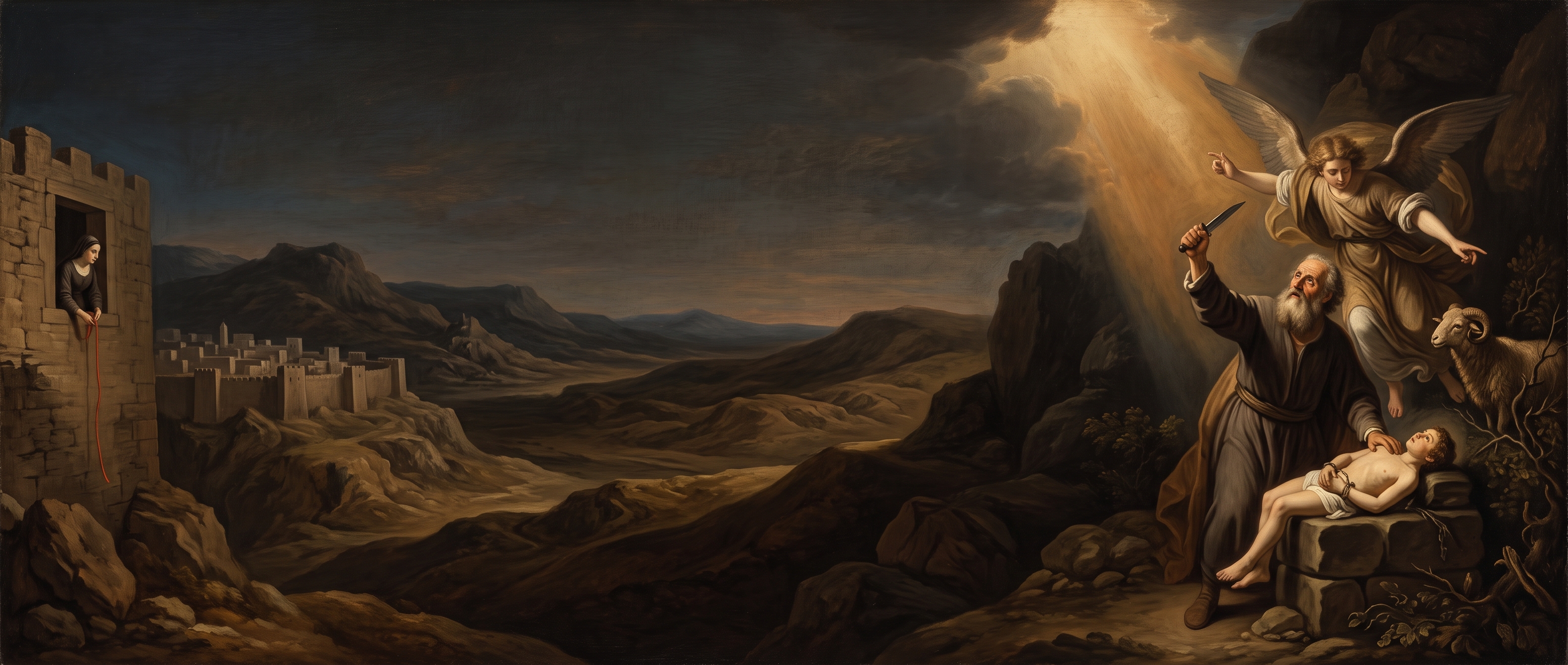
The Abrahamic Trajectory: Genesis 15:6 records that Abram believed the Lord's promise regarding an heir, and He reckoned it (chashav) to him for righteousness. Textually, this divine reckoning occurred prior to the covenant enactment of Genesis 15:9–17, at least fourteen years prior to the institution of circumcision in Genesis 17. This chronological interval is verified by the narrative timeline: Abram was seventy-five years old when he departed Haran (Gen 12:4), had dwelt ten years in the land of Canaan when Sarai gave him Hagar at age eighty-five (Gen 16:3), was eighty-six at Ishmael's birth (Gen 16:16), and was ninety-nine when the covenant sign of circumcision was commanded (Gen 17:1). Furthermore, this reckoning occurred decades before the binding of Isaac (Gen 22). As Paul underscores in Romans 4:10, righteousness was imputed to Abraham while he was yet uncircumcised. Decades later, following Abraham's obedience on Mount Moriah, God declared: "For now I know that thou fearest God, seeing thou hast not withheld thy son... because thou hast done this thing... and in thy seed shall all the nations of the earth be blessed; because thou hast obeyed my voice" (Gen 22:12, 16, 18). Subsequent canonical witnesses confirm this trajectory: God reaffirmed the covenantal oath to Isaac because "Abraham obeyed my voice, and kept my charge, my commandments, my statutes, and my laws" (Gen 26:5), while the post-exilic Levitical confession in Nehemiah 9:7–8 looks back to God choosing Abram and finding "his heart faithful before thee." In the New Testament, Hebrews 11:17–19 explicitly anchors the Moriah offering within faith: "By faith Abraham, when he was tried, offered up Isaac... accounting that God was able to raise him up, even from the dead."
-
The Zealous Intervention of Phinehas (Psalm 106:30–31; Numbers 25:11–13): During the apostasy at Baal-peor, Phinehas executed judgment upon the brazen offenders: "Then stood up Phinehas, and executed judgment: and so the plague was stayed. And that was counted unto him for righteousness unto all generations for evermore" (Ps 106:30–31). This reproduces the same canonical idiom found in Genesis 15:6, sharing an identical Greek translation in the Septuagint (elogisthē autō eis dikaiosynēn), though the Hebrew texts exhibit different grammatical structures: Genesis 15:6 employs an active construction with Abram's faith as the implicit object (wayyaḥšəḇehā lô ṣəḏāqāh), whereas Psalm 106:31 employs a passive construction with Phinehas's physical deed as the subject (wattēḥāšeḇ lô liṣdāqāh).
-
Rahab of Jericho (Joshua 2; 6): Rahab received the Israelite messengers and dispatched them by an alternate route. Hebrews 11:31 attributes her preservation to faith (pistei), whereas James 2:25 explicitly affirms that she was "justified by works" (ex ergōn edikaiōthē).
-
The Penitent Thief (Luke 23:39–43): Crucified adjacent to Christ, the dying criminal possessed no opportunity for sustained ethical labor, legal restitution, or ritual observance. Yet his faith was vocalized through concrete action: he rebuked his fellow transgressor, confessed the equity of their condemnation, attested to Christ’s absolute innocence, acknowledged His royal dominion, and cast himself upon His mercy. Christ granted him the immediate promise of paradise.
3. Canonical Types and Analogies of Deliverance
-
The Paschal Lamb (Exodus 12:12–13; 1 Corinthians 5:7): The objective ground of deliverance was the shed blood applied to the lintel and doorposts, turning away the destroyer irrespective of the moral history of the household. Nevertheless, deliverance was mediated through the concrete act of applying the blood and remaining within the shelter.
-
The Bronze Serpent (Numbers 21:8–9; John 3:14–15): Immunity from lethal venom required neither self-generated remedies nor physical exertion; it was mediated entirely through an outward, trusting gaze directed toward God’s appointed provision.
4. Prophetic Foundations and Eschatological Realities
-
The Objective Ground (Isaiah 53:11): The Suffering Servant of Yahweh acts as a vicarious substitute: "By his knowledge shall my righteous servant justify many; for he shall bear their iniquities." Judicial righteousness is anchored in the Servant's sin-bearing sacrifice.
-
The Regenerating Spirit (Ezekiel 36:26–27): The prophetic vision of the New Covenant promises internal transformation: God removes the stony heart, imparts a heart of flesh, and indwells His people by His Spirit to "cause you to walk in my statutes, and ye shall keep my judgments, and do them." Obedience is the direct consequence of regeneration by the Spirit.
-
Final Judgment According to Deeds: The canonical witness consistently depicts eschatological judgment as evaluating human speech, conduct, and fidelity (Matt 12:37; 25:31–46; Rom 2:6, 13; 2 Cor 5:10).
5. Canonical Concord in Historical Reality: Acts and Galatians
The canonical record demonstrates that the apostolic leaders did not proclaim divergent gospels:
-
The Right Hand of Fellowship (Galatians 2:9): Paul notes that when James, Cephas, and John perceived the grace committed to him, they extended to him and Barnabas "the right hands of fellowship," ratifying their mutual recognition in the gospel.
-
The Incident at Antioch (Galatians 2:11–14): In Galatians 2:12, Paul notes that Peter withdrew from Gentile table fellowship when "certain came from James." Yet Paul's rebuke is directed specifically at Peter's inconsistency and the hypocrisy of those who withdrew with him, not at James himself. Paul never charges James with teaching another gospel, and the broader narrative demonstrates continuous fellowship between the Jerusalem leadership and Paul.
-
The Jerusalem Council (Acts 15:1–29): Confronting the insistence that Gentile converts submit to circumcision and the law of Moses (Acts 15:5), Peter attested that God "put no difference between us and them, purifying their hearts by faith," concluding that "through the grace of the Lord Jesus Christ we shall be saved, even as they" (Acts 15:9, 11). James explicitly concurred, offering the definitive proposal (Acts 15:13–21) that led the whole council—apostles, elders, and church—to formulate and send the decree freeing Gentiles from ceremonial law (Acts 15:22–29).
-
Paul’s Deliberation with James (Acts 21:18–26): Upon Paul’s final arrival in Jerusalem, he met with James and all the elders, recounting his ministry among the Gentiles, whereat "they glorified the Lord" (Acts 21:20). While James observed the ongoing zeal for ancestral customs among Jewish believers, he reaffirmed the council's decision regarding Gentile freedom (Acts 21:25), demonstrating doctrinal solidarity between the two apostles.
II. Exegetical Analysis of Semantic Fields
The apparent dissonance between canonical witnesses is resolved by recognizing that Paul and James operate with distinct definitions of primary terms governed by their immediate rhetorical settings.
1. The Semantic Field of "Works"
-
Paul’s Usage: Paul primarily confronts two errors:
-
Works of the Law (ergōn nomou): Jewish identity markers (circumcision, dietary boundaries) that divided Jewish and Gentile believers (Gal 2:12–16), as well as the broader moral demand of the Torah (Rom 2–3; Gal 3:10), which fallen humanity cannot perfectly fulfill.
-
Commercial Debt (ergazomai and misthos): In Romans 4:4–5, Paul invokes an economic paradigm: labor yields an earned wage that constitutes a legal debt (opheilēma), not grace. Paul excludes human works to eliminate the notion that human initiative can place God in human debt.
-
-
James’s Usage: James never employs the technical Pauline phrase "works of the law." He does not address ceremonial boundaries or attempts to establish legal claim upon God. His "works" (erga) denote practical acts of covenant charity—relieving the destitute and hungry (Jas 2:15–16)—and concrete acts of sacrificial obedience, exemplified by Abraham's offering on Mount Moriah (Jas 2:21). James targets an inert, disembodied confession.
2. The Semantic Field of "Faith"
-
Paul’s Usage: Faith (pistis) is personal entrustment, allegiance, and union with Jesus Christ. It is a living, operative principle that yields the "obedience of faith" (hypakoē pisteōs, Rom 1:5; 16:26) and functions dynamically through love (pistis di’ agapēs energoumenē, Gal 5:6).
-
James’s Usage: James confronts a hypothetical interlocutor who merely claims to possess faith: "What doth it profit, my brethren, though a man say he hath faith, and have not works? can faith save him?" (Jas 2:14). The anaphoric article (hē pistis, "that faith") denotes the spurious posture under review—a barren verbal assertion. James demonstrates that such faith is indistinguishable from demonic intellectual assent: the demons affirm monotheistic truth and shudder, yet remain entrenched in rebellion (Jas 2:19). Bare cognitive agreement without moral response does not constitute saving trust.
3. The Metaphor of the Body and Breath (James 2:26)
James concludes his argument with an anatomical analogy:
Body is to breath as faith is to works.
In Greek, pneuma signifies both "breath" and "spirit." James’s immediate analogy is somatic: just as a physical body without breath is an inert cadaver, so faith without works is dead. Here, James maps works to the animating breath (pneuma) and faith to the body. A faith that produces no bodily obedience is functionally dead.
Works are the vital breath proving that a professed faith is alive.
III. The Meaning of "Justification" (Dikaioō) in Canonical Context
1. The Context of Demonstration: Sight, Maturation, and Fulfillment (James 2:18–24)
To understand James’s use of dikaioō, the term must be read within the visual and demonstrative framework he establishes:
-
The Call to Demonstration (James 2:18): James frames his entire thesis around tangible demonstration: "Yea, a man may say, Thou hast faith, and I have works: shew me thy faith without thy works, and I will shew thee my faith by my works." Faith cannot be inspected directly; it is verified only through its visible effects.
-
The Vocabulary of Sight (James 2:22, 24): James directs his readers to visual evaluation: "Seest thou [blepeis] how faith wrought with his works, and by works was faith made perfect? ... Ye see [horate] then how that by works a man is justified, and not by faith only." The justification James describes is an observable reality grounded in historical evidence.
-
The Maturation of Faith (teleioō, James 2:22): The verb teleioō denotes bringing an entity to its intended goal, maturity, or full operational expression (as in 1 John 4:12). Abraham's works did not generate a previously absent faith; rather, faith cooperated with (synērgei) his deeds, bringing his interior trust to visible completion on Mount Moriah.
-
The Historical Fulfillment of Imputation (James 2:23): James asserts: "And the scripture was fulfilled which saith, Abraham believed God, and it was imputed unto him for righteousness: and he was called the Friend of God." Genesis 15:6 was declared decades prior to Genesis 22. James states that Genesis 15:6 was fulfilled (eplērōthē) on Moriah. In canonical usage, an earlier divine declaration is fulfilled when it reaches its embodied historical realization. Abraham's unreserved obedience on Moriah provided tangible historical verification of the reckoning of Genesis 15:6. The covenant title "Friend of God" directly reflects canonical precedent (2 Chr 20:7; Isa 41:8: "the seed of Abraham my friend").
2. Declarative, Evaluative, and Judicial Usages of Dikaioō
Because James grounds his discussion in visible demonstration, his usage aligns naturally with the broad canonical range of dikaioō, which routinely denotes the public vindication or evaluation of an existing reality rather than the initial conferral of legal righteousness:
-
The Vindication of God: In Romans 3:4, quoting Psalm 51:4 (LXX 50:6), David prays: "That thou mightest be justified in thy sayings" (hopōs an dikaiōthēs en tois logois sou). God receives no new legal status; His existing righteousness is publicly vindicated against human accusation. Similarly, Luke 7:29 records that the people "justified God" (edikaiōsan ton theon) upon hearing John's baptism.
-
The Vindication of Wisdom: Jesus declares: "Wisdom is justified of all her children" (Luke 7:35; Matt 11:19). Wisdom's true character is vindicated and proved right by its outward fruit.
-
Human Self-Vindication: When the lawyer sought to "justify himself" (Luke 10:29) or Jesus observed of the Pharisees, "Ye are they which justify yourselves before men" (Luke 16:15), the issue was an external demonstration of righteousness before human observers.
-
Judicial Declarations in the Old Testament: In the judicial statutes of the Old Testament, judges are explicitly commanded to execute righteous judgment: they must "justify the righteous, and condemn the wicked" (Deut 25:1). Conversely, Scripture repeatedly condemns the perversion of justice: "He that justifieth the wicked, and he that condemneth the just, even they both are abomination to the LORD" (Prov 17:15). In the judicial code of Exodus 23:7, the Greek translation addresses the human magistrate with an absolute prohibition (ou dikaiōseis ton asebē, "thou shalt not justify the wicked"), reflecting the divine standard expressed in the Masoretic text where God declares, "I will not justify the wicked" (lōʾ-ʾaṣdîq rāšāʿ).
This strict judicial standard creates an acute canonical tension when Paul declares in Romans 4:5 that God "justifieth the ungodly" (dikaiounta ton asebē). Paul's statement is a present-tense judicial verdict, directly addressing the prohibition of Exodus 23:7 and Proverbs 17:15. This tension is resolved canonically by Isaiah 53:11: God can declare the ungodly righteous without compromising His justice because the righteous Servant "shall bear their iniquities." The divine acquittal is grounded entirely in the substitutionary atonement of Christ. When James uses dikaioō, however, he is not addressing how an ungodly sinner receives forgiveness; he is demonstrating how that imputed righteousness is outwardly verified and vindicated through works.
3. Eschatological Evaluation and Fruit: Matthew 12:37
In Matthew 12:37, Jesus declares: "For by thy words thou shalt be justified, and by thy words thou shalt be condemned." Read in isolation, this might appear to establish verbal performance as the meritorious basis of acquittal. Yet the immediate literary context of Matthew 12:33–35 clarifies the principle:
"Either make the tree good, and his fruit good; or else make the tree corrupt, and his fruit corrupt: for the tree is known by his fruit... out of the abundance of the heart the mouth speaketh. A good man out of the good treasure of the heart bringeth forth good things: and an evil man out of the evil treasure bringeth forth evil things."
Words do not create the nature of the tree; they reveal it. The speech evaluated at the judgment seat functions as external, revelatory evidence of the interior condition of the heart.
4. The Canonical Parallel of Phinehas (Psalm 106:30–31; Numbers 25:11–13)
Psalm 106:30–31 provides the closest canonical parallel to Genesis 15:6:
-
Genesis 15:6 (Hebrew active): wayyaḥšəḇehā lô ṣəḏāqāh — He reckoned it to him as righteousness.
-
Psalm 106:31 (Hebrew passive): wattēḥāšeḇ lô liṣdāqāh — And it was reckoned to him for righteousness.
-
LXX (both passages): kai elogisthē autō eis dikaiosynēn.
In Numbers 25:11–13, God established with Phinehas a "covenant of peace... even the covenant of an everlasting priesthood; because he was zealous for his God, and made an atonement for the children of Israel."
The phrase "made an atonement" (wayḵappēr) indicates that Phinehas's intervention stayed divine wrath from consuming the congregation. While Paul in Romans 4:4 states that reward is reckoned (logizetai) "of debt" to the one who works, the reckoning in Psalm 106:31 is not commercial compensation or wages owed; it is a divine commendation of covenant loyalty. Psalm 106 does not teach that Phinehas earned initial pardon of sins through physical force, but that his zealous deed was evaluated by God and recognized (chashav) as a righteous act preserving the covenant community. It stands as a canonical example of God publicly recording and vindicating a concrete work of faith.
5. "Doers of the Law" in Romans 2:13
Paul asserts: "For not the hearers of the law are just before God, but the doers of the law shall be justified." Within the broader discourse of Romans:
-
The Indictment of Self-Reliance: In Romans 1:18–3:20, Paul refutes all claims of moral superiority. Merely hearing the Torah provides no security; the law requires perfect obedience. Because Paul concludes that "there is none righteous, no, not one" (Rom 3:10) and "by the deeds of the law there shall no flesh be justified in his sight: for by the law is the knowledge of sin" (Rom 3:20), Romans 2:13 establishes an unyielding standard that exposes human guilt and directs the sinner to Christ.
-
The Inward Fulfillment by the Spirit: In Romans 2:28–29 and Romans 8:3–4, Paul looks to the inward circumcision of the heart by the Spirit, through whom the righteous requirement of the law is fulfilled in those who walk not after the flesh, but after the Spirit. Believers are doers of the law through the Spirit, not to earn acceptance, but as the fruit of their union with Christ.
IV. The Scriptural Imagery of the "Seal" (Sphragis / Sphragizō)
To integrate the declarative verdict of Paul and the active vindication of James, Scripture provides the unifying motif of the seal (sphragis, Rom 4:11; 2 Tim 2:19) and the divine act of sealing (sphragizō, Eph 1:13; 4:30; 2 Cor 1:22). Across the canon, Scripture explicitly designates circumcision (Rom 4:11), the foundation inscription (2 Tim 2:19), and the Holy Spirit (Eph 1:13; 2 Cor 1:22) as seals, each operating as an authoritative mark of divine ownership, covenant reality, and preservation.
1. The Dual Inscription of the Seal (2 Timothy 2:19)
The comprehensive definition of the divine sphragis appears in 2 Timothy 2:19. Significantly, this affirmation arises in direct response to covenant deviation: Paul notes that Hymenaeus and Philetus had erred concerning the truth and overthrown the faith of some (2 Tim 2:17–18). In the face of visible falling away, Paul immediately anchors the believer's security in the unshakeable divine foundation:
"Nevertheless the foundation of God standeth sure, having this seal, The Lord knoweth them that are his. And, Let every one that nameth the name of Christ depart from iniquity."
The seal exhibits two distinct inscriptions declaring God's ownership:
-
The Divine Face: "The Lord knoweth them that are his." God's sovereign, inward knowledge of His own is immediate, interior, and infallible. Before His omniscient gaze, divine knowledge requires no secondary demonstration.
-
The Historical Face: "Let every one that nameth the name of Christ depart from iniquity." Before human observers, and at the judgment where God "will make manifest the counsels of the hearts" (1 Cor 4:5; cf. Rom 2:5, 16; 2 Cor 5:10, where the Greek is phanerōthēnai, "be made manifest"), genuine belonging is revealed by departure from iniquity.
2. The Outer Seal and the "Steps of Faith" (Romans 4:11–12)
In Romans 4:11–12, Paul explicitly applies the category of the seal to Abraham:
"And he received the sign of circumcision, a seal of the righteousness of the faith which he had yet being uncircumcised... to them who also walk in the steps of that faith of our father Abraham, which he had being yet uncircumcised."
Circumcision did not create Abraham's righteousness; it served as an outward seal of the righteousness imputed to him while uncircumcised. Paul immediately adds verse 12: the true heirs of Abraham are those who "walk in the steps of that faith." Walking in those steps (exemplified in Genesis 22) is the living imprint of the seal.
3. The Inward Seal of the Spirit (Ephesians 1:13; 4:30; 2 Corinthians 1:22)
In the New Covenant, the seal is pneumatological:
"In whom also after that ye believed, ye were sealed with that holy Spirit of promise." (Eph 1:13)
The Holy Spirit Himself is the divine seal set upon the believer, operating as the pledge and earnest (arrabōn, 2 Cor 1:22; Eph 1:14) of future redemption. Scripture names circumcision, the divine inscription, and the Holy Spirit as seals, but never works. Rather, works constitute the visible, historical imprint left by that divine seal in human life.
V. Evaluating the Two Canonical Readings
Biblical soteriology rests upon three primary canonical pillars:
| Soteriological Dimension | Theological Definition | Scriptural Anchors |
|---|---|---|
| Sovereign Source | God's unmerited grace alone | Ephesians 2:8–9; Romans 3:24; Titus 3:4–5 |
| Meritorious Ground | Christ's substitutionary atonement alone | Isaiah 53:11; Romans 5:18–19; 1 Corinthians 5:7 |
| Receptive Instrument | Living, self-entrusting faith apart from works | Romans 3:28; 4:5–6; Galatians 2:16 |
Canonical interpreters integrate this baseline across Scripture through two distinct readings:
-
Model A: The Vindicative / Demonstrative Reading:Core Principle: The divine verdict of justification is granted upon faith without the deeds of the law (Rom 3:28; 4:5–6; 5:1). Works do not form any part of the ground or instrument of justification; rather, they serve as the necessary fruit, evidence, and public vindication of that faith before God and humanity (Jas 2:18, 21–24; Matt 12:37; 2 Tim 2:19).
-
Model B: The Transformative / Covenant-Fidelity Reading:Core Principle: Justification cannot be restricted to an initial declarative moment, but encompasses the final eschatological verdict. While entrance into the covenant is by unmerited grace through faith, the final verdict at the judgment seat genuinely evaluates and takes into account the actual, Spirit-wrought fidelity and works of the believer (Rom 2:6, 13; Jas 2:24; Matt 25:31–46).
Canonical Matrix of Challenging Texts
The following matrix evaluates how both readings account for the full spectrum of canonical texts, including both severe warnings and explicit assurances:
| Scriptural Witness | Model A: Vindicative / Demonstrative | Model B: Transformative / Covenant-Fidelity |
|---|---|---|
| Sealed Until Redemption (Eph 1:13–14; 4:30; 2 Cor 1:22) | Natural: The Spirit is the "earnest of our inheritance" and seals "unto the day of redemption." | Reply & Strain: B replies that the Spirit seals covenant membership so long as one abides, but Ephesians 4:30 warns only against grieving the Spirit, never indicating that the divine seal is broken or annulled. |
| Held in the Hand (John 6:37–40; 10:27–29) | Natural: Christ loses none given to Him, and none can pluck them from His hand. | Reply & Strain: B replies that "no man is able to pluck them out" refers to external adversaries, not voluntary apostasy. Yet John 10:28 explicitly guarantees that "they shall never perish," and John 6:39 affirms Christ will lose nothing of all the Father has given Him. |
| The Unbroken Chain (Rom 8:30, 38–39; Phil 1:6) | Natural: Those justified are glorified in the divine purpose, and the good work begun will be performed "until the day of Jesus Christ." | Reply & Strain: B replies that the chain represents God's corporate purpose for the covenant body, not an individual guarantee. However, Paul frames the passage around the personal assurance of the elect against every charge. |
| The Dying Criminal (Luke 23:42–43) | Natural: Trust was immediately present; Christ pronounced his salvation prior to an extended life of good deeds. | Coherent / Neutral: His public confession of guilt and Christ's kingship constituted genuine Spirit-wrought covenant fidelity under his circumstances. |
| Justifying the Ungodly (Rom 4:5) | Natural: God declares the ungodly righteous while still lacking works, reckoning faith as righteousness. | Reply & Strain: B affirms entrance is purely by grace, viewing the verdict as genuine now and confirmed at the end. Yet Paul presents the reckoning as complete and declarative, citing David's blessedness where God "imputeth righteousness without works" and "will not impute sin" (Rom 4:6, 8). |
| Phinehas Reckoned Righteous (Ps 106:30–31) | Answer: An act of covenant zeal was publicly recognized and credited as righteous obedience preserving the covenant community; it does not describe initial conversion or the pardon of sin. | Natural: An obedient deed is directly reckoned unto righteousness, showing that actions form the material of divine approval. |
| The Abrahamic Sequence (Gen 15:6 vs. Gen 22:12, 16) | Natural: Righteousness was reckoned in Gen 15:6; Gen 22 tested, matured (eteleiōthē), and historically demonstrated that existing faith. | Reply & Strain: B replies that Genesis 15:6 was a true covenantal beginning, but Isaac's offering completed Abraham's justification. Yet Romans 4:10 establishes that the reckoning was definitive while uncircumcised, at least fourteen years prior to Genesis 17 and decades prior to Genesis 22. |
| Syntax of James 2:24 (“By works a man is justified”) | Strained: Must read dikaioō in an evaluative/demonstrative sense, supported by the context of sight (blepeis, horate) and demonstration (Jas 2:18). | Natural: Takes the grammar at face value: works are an actual factor in a person's justification. |
| Warnings: Apostasy & Falling Away (Heb 6:4–8; Heb 10:26–29) | Answer: Those who fall away demonstrate that their initial participation lacked saving faith (Heb 3:14; 1 John 2:19), or they face severe temporal covenant judgment and loss of inheritance. | Natural: Genuine partakers of the covenant who fail to persevere in obedience forfeit their ultimate salvation. |
| Departure and Iniquity (Matt 7:21–23) | Natural: Parallels 2 Timothy 2:19 directly: Christ states, "I never knew you," proving they were never savingly known, notwithstanding their external religious works. | Reply & Strain: B replies that those who did works in Jesus' name had real standing but fell away. Yet Christ does not say "I once knew you and ceased to know you," but "I never knew you." |
| The Severed Branch (John 15:6) | Answer: Inwardly fruitless attachment to the outward community is removed; true vitality always produces fruit (John 15:5, 8). | Natural: Union with Christ is real, but failure to produce works leads to final rejection and burning. |
| The Severed Olive Branch (Rom 11:22) | Answer: Addressed corporately to Gentiles regarding their tenure in the covenant olive tree through faith, warning against boasting. | Natural: Individual continuance in God's goodness is contingent upon ongoing fidelity. |
| Sowing to the Flesh vs. Spirit (Gal 5:19–21; 6:7–9; Rom 8:13) | Answer: A lifestyle of willful fleshly sin reveals an unregenerate heart that has no inheritance in Christ; living by the Spirit is the necessary fruit of regeneration. | Natural: Sowing to the Spirit and putting to death the deeds of the body are conditions for reaping eternal life. |
| Patient Continuance in Well Doing (Rom 2:7, 10) | Answer: Describes the character of those who seek glory and honor, whose works at the judgment confirm their regenerate status. | Natural: Eternal life is rendered to those who fulfill the condition of patient continuance in good works. |
VI. Synthesis: The Seal of Faith
When the canonical evidence is weighed across both testaments, the Vindicative/Demonstrative reading (Model A) provides the most coherent integration of the biblical text without diminishing the absolute gravity of the warning passages.
Model A accounts for both the canonical warnings and the explicit assurances by recognizing that Scripture links sovereign preservation with active human perseverance. Spirit-wrought obedience is the assured fruit of a new nature, yet worked out through the believer's own exertion. Scripture resolves the relationship between divine preservation and human responsibility by demonstrating that God’s inward work and human action operate concurrently: "Work out your own salvation with fear and trembling. For it is God which worketh in you both to will and to do of his good pleasure" (Phil 2:12–13). Believers are therefore exhorted to "give diligence to make your calling and election sure" (2 Pet 1:10), because ethical diligence verifies the reality of the divine election.
Within this framework, the canonical warnings function not as threats that God will revoke His declarative verdict, but as the sober, operative means through which the Spirit preserves the elect in perseverance. Thus, immediately following the severe warning of Hebrews 6:4–8, the author writes: "But, beloved, we are persuaded better things of you, and things that accompany salvation, though we thus speak" (Heb 6:9). The warnings preserve God's people by calling them away from iniquity and pointing them to the unshakeable certainty of the divine promise (Heb 6:11–20).
1. Distinct Questions, One Gospel
Paul and James address distinct errors:
-
Paul’s Concern: The Ground of Acceptance. Paul excludes human boasting. No individual can treat salvation as earned compensation (Rom 4:4), nor can any person be justified by observing the Mosaic law (Rom 3:20). The sole ground of acceptance is Christ’s shed blood; the sole instrument is trusting faith without the deeds of the law (Rom 3:28; 4:5–6).
-
James’s Concern: The Authenticity of Profession. James excludes dead orthodoxy. A confession of faith that leaves a brother or sister naked and destitute of daily food is void of spiritual reality (Jas 2:15–17). Even demons believe that God is one, and shudder (Jas 2:19). Saving faith is not abstract assent; it is alive, active, and demonstrated in history (Jas 2:18).
That Paul and James stand in doctrinal concord is confirmed by the canonical record: James extended the right hand of fellowship to Paul (Gal 2:9), Peter and James stood with Paul at the Jerusalem Council to free Gentile converts from legal observances (Acts 15), and Paul affirmed that faith must work through love (Gal 5:6).
2. Canonical Deliberation and Open Contestation
Passages such as Hebrews 6:4–8 and 10:26–29 remain points where careful readers who affirm both sovereign grace and covenant holiness continue to disagree; this study does not claim to exhaustively settle every facet of their interpretation, but to argue which hermeneutical framework most coherently integrates the canonical data across both testaments.
3. The Living Seal
The relationship between faith, works, and justification is unified in the canonical motif of the seal:
-
The Inward Seal: In the interior, invisible sphere, "The Lord knoweth them that are his" (2 Tim 2:19a). God's omniscient eye discerns saving faith the instant it is conceived, sealing the believer with the Holy Spirit of promise unto the day of redemption (Eph 1:13; 4:30; 2 Cor 1:22). In this declarative sense, the ungodly are justified by faith without works (Rom 4:5–6).
-
The Outward Imprint: In the exterior, historical sphere, "Let every one that nameth the name of Christ depart from iniquity" (2 Tim 2:19b). When God manifests the secrets of all hearts, that inward reality is publicly verified by its visible imprint. Abraham walked in the steps of faith (Rom 4:12), offering Isaac decades after his initial justification, thereby fulfilling the scripture and demonstrating that his faith was alive (Jas 2:21–23).
Works neither purchase the divine verdict nor place God in human debt. Rather, they stand as the living imprint of the Spirit's seal—the visible, necessary vindication of an authentic, life-giving faith.