Faith, Works, and Justification in Paul and James
"Ye see then how that by works a man is justified, and not by faith only."
"...but faith which worketh by love."
Abstract
Within biblical theology, the relationship between the Pauline epistles and the Epistle of James remains a central hermeneutical crux. Where Paul concludes that an individual is justified by faith apart from the deeds of the law (Rom 3:28), James counters that a person is justified by works and not by faith only (Jas 2:24). This study conducts an inductive canonical investigation across both testaments to examine the textual, lexical, and structural foundations of this tension. By analyzing explicit formulae, narrative paradigms (the Abrahamic sequence, Rahab, the dying criminal), typological deliverances, and eschatological judgment passages, the paper clarifies the semantic fields of "faith," "works," and "justification." It then evaluates two major hermeneutical paradigms—the Vindicative/Demonstrative model and the Transformative/Covenant-Fidelity model—to assess how each accounts for the canonical data without flattening the distinct voices of the biblical authors.
I. The Canonical Witnesses
An inductive inquiry requires cataloging the primary biblical data in their respective literary contexts before attempting theological integration.
1. Affirmative and Negative Formulae
- James 2:24: "Ye see then how that by works a man is justified, and not by faith only." The phrase "faith only" (pisteōs monon) appears in the New Testament solely in this verse, conjoined with the negative particle ouk.
- Romans 3:28: "Therefore we conclude that a man is justified by faith without the deeds of the law" (chōris ergōn nomou).
- Romans 4:4–5: "Now to him that worketh is the reward not reckoned of grace, but of debt. But to him that worketh not, but believeth on him that justifieth the ungodly, his faith is counted for righteousness."
- Ephesians 2:8–10: "For by grace are ye saved through faith; and that not of yourselves: it is the gift of God: Not of works, lest any man should boast. For we are his workmanship, created in Christ Jesus unto good works, which God hath before ordained that we should walk in them."
- Galatians 5:6: "For in Jesus Christ neither circumcision availeth any thing, nor uncircumcision; but faith which worketh by love" (pistis di’ agapēs energoumenē).
2. Narrative Case Studies
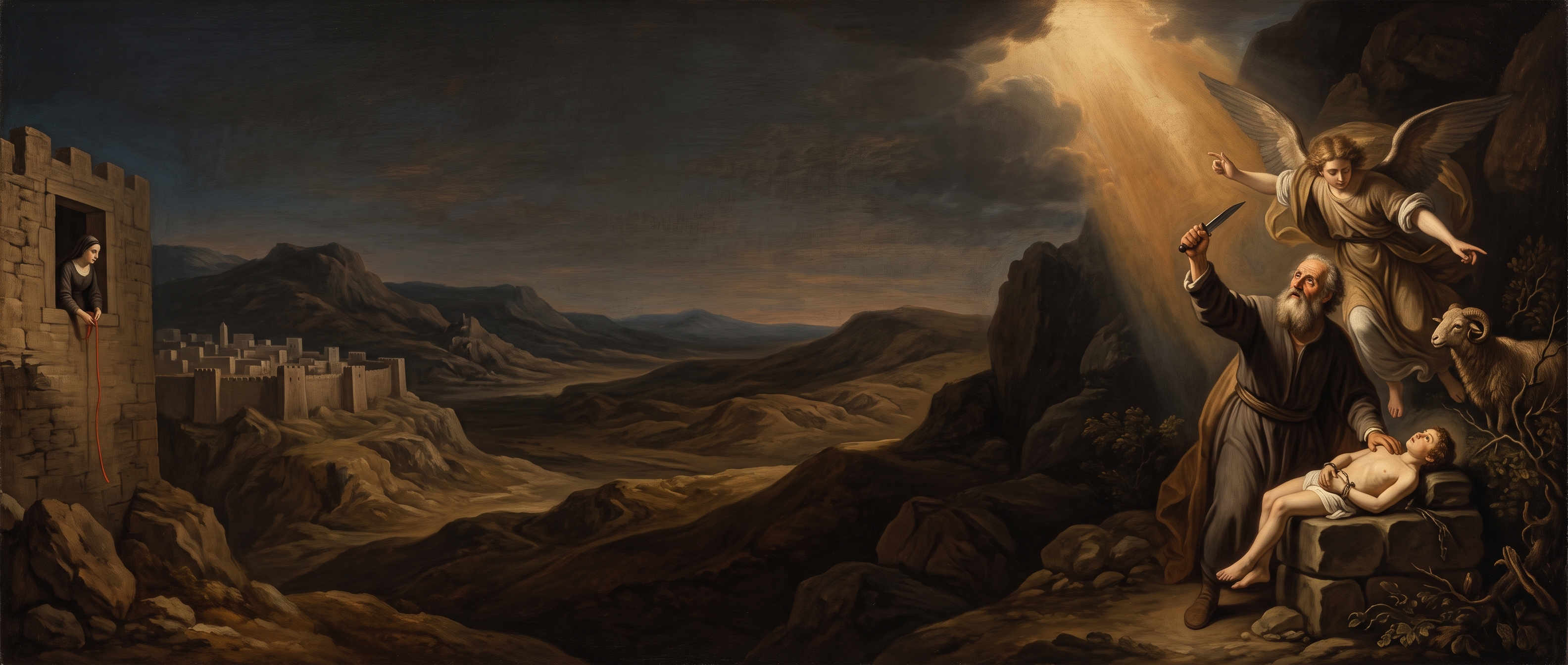
- The Abrahamic Trajectory: Genesis 15:6 records that Abram believed Yahweh's promise regarding a future heir, and it was reckoned (chashav) to him as righteousness. This forensic reckoning occurred prior to the covenant ceremony of Genesis 15:9–17, decades prior to the institution of circumcision (Gen 17), and roughly thirty years prior to the binding of Isaac (Gen 22). Decades later, following Abraham's obedience on Mount Moriah, God declared: "For now I know that thou fearest God, seeing thou hast not withheld thy son... because thou hast done this thing... and in thy seed shall all the nations of the earth be blessed; because thou hast obeyed my voice" (Gen 22:12, 16, 18).
- Rahab of Jericho (Josh 2; 6): Rahab hid the messengers and hung the scarlet cord. Hebrews 11:31 attributes her survival to faith (pistei), whereas James 2:25 explicitly states that she was "justified by works" (ex ergōn edikaiōthē) when she received the messengers and sent them out by another path.
- The Penitent Thief (Luke 23:39–43): Crucified beside Jesus, the dying criminal had no opportunity for a sustained life of ethical labor, ongoing charity, or covenant rituals. Yet even within the physical limits of crucifixion, his faith was not passive: he rebuked the other criminal, confessed their shared guilt, publicly attested to Jesus's innocence, acknowledged His royal authority, and cast himself upon Jesus's mercy. Upon this confession of trust, he received the immediate promise of paradise.
3. Canonical Types and Analogies of Deliverance
- The Passover (Exod 12:12–13; 1 Cor 5:7): Paul directly links Christ to the Passover sacrifice: "For even Christ our passover is sacrificed for us." In the Exodus narrative, the ground of deliverance was the shed blood applied to the doorposts, which averted the destroyer regardless of the moral pedigree of the household; nevertheless, safety was mediated through the act of applying the blood and remaining indoors.
- The Bronze Serpent (Num 21:8–9; John 3:14–15): Jesus cites Moses lifting the serpent as a type of His own crucifixion. Afflicted Israelites were preserved from fatal venom by looking to God’s appointed provision outside themselves; life was received through sight, independent of physical remedies or moral exertion.
- The Wilderness Generation (Num 14; Heb 3:18–19): Despite initial deliverance from Egypt, Israel fell in the desert. Hebrews 3 connects their failure to enter God’s rest to a refusal to obey (apeithēsasin, v. 18), which the author traces directly to an underlying condition of unbelief (apistian, v. 19).
4. Prophetic Foundations and Eschatological Judgment
- The Objective Ground (Isa 53:11): The Suffering Servant acts as a vicarious substitute: "By his knowledge shall my righteous servant justify many; for he shall bear their iniquities." The meritorious basis for justification is situated in the Servant's sacrificial bearing of sins.
- The Subjective Transformation (Ezek 36:26–27): The New Covenant includes an internal moral renewal: God replaces the stony heart with a heart of flesh and imparts His Spirit specifically to "cause you to walk in my statutes, and ye shall keep my judgments, and do them."
- Judgment According to Deeds (Matt 25:31–46; Rom 2:6, 13): Scriptural descriptions of the final judgment consistently evaluate human action. In Matthew 25, the separation of the sheep and goats is narrated in terms of practical mercy (feeding the hungry, clothing the naked). In Romans 2:6 and 13, Paul states that God "will render to every man according to his deeds" and that "not the hearers of the law are just before God, but the doers of the law shall be justified."
II. Exegetical Analysis of Semantic Fields
Much of the tension between canonical witnesses stems from assuming that Paul and James operate with identical definitions for identical terms.
The Semantic Field of "Works"
Paul’s vocabulary of "works" is multifaceted across his letters:
- The Mosaic Torah and Covenant Distinction: In Romans 3:28 and Galatians 2:16, Paul specifically targets "works of the law" (ergōn nomou). The immediate literary context of Galatians 2:11–14 focuses squarely on practices that distinguished Jewish covenant life from Gentiles—principally circumcision, table fellowship, and dietary boundaries. Yet Paul’s argument in Galatians 3:10 and Romans 2–3 establishes that his critique also encompasses the moral stipulations of the Torah, which bring condemnation because fallen humanity fails to abide by all things written in the book of the law to do them.
- Economic Obligation and Universal Human Effort: In Romans 4:4–5, Paul broadens his terminology beyond Mosaic statutes to an economic analogy: labor, wages, and contractual debt (opheilēma). To "work" in this sense denotes human effort rendered as an earned claim against God, which Paul sets in sharp contrast to receiving righteousness as an unmerited gift.
James, in contrast, uses "works" (erga) to describe practical acts of covenant charity—relieving the destitute and hungry (Jas 2:15–16)—and concrete acts of obedience under severe testing, such as Abraham's binding of Isaac (Jas 2:21). James is not addressing ceremonial legislation or commercial debt-claims; his critique targets an idle, disembodied profession of religion.
The Semantic Field of "Faith"
For Paul, faith (pistis) is whole-person entrustment, allegiance, and union with Jesus Christ. This posture is not passive; it inherently produces what Paul calls the "obedience of faith" (hypakoē pisteōs, Rom 1:5; 16:26) and operates dynamically through love (pistis di’ agapēs energoumenē, Gal 5:6).
James, however, addresses an interlocutor who merely claims to possess faith (ean pistin legē tis echein, Jas 2:14). James compares this idle posture to demonic intellectual assent: the demons affirm the monotheistic truth of the Shema and shudder, yet remain in rebellion against God (Jas 2:19). For James, bare cognitive agreement without moral response does not rise to the level of saving trust.
The Anatomy of the Metaphor in James 2:26
James concludes his argument with an anatomical analogy:
Body : Spirit/Breath :: Faith : Works
A physical body deprived of breath (pneuma) is an inert cadaver. James does not present works merely as incidental adornments on a living body. Rather, an alleged faith that produces no bodily obedience is functionally dead.
III. The Meaning of "Justification" (Dikaioō) in Context
To determine how James conceptualizes justification, inquiry cannot rely solely on the conversational exchange in verse 18 ("Show me thy faith without thy works, and I will show thee my faith by my works"). The primary evidence must be drawn directly from the structural and textual progression of James 2:21–25, evaluated alongside Paul's own usage in passages like Romans 2:13.
1. The Maturing of Faith (James 2:22)
James writes: "Seest thou how faith wrought with his works, and by works was faith made perfect?" The Greek verb for "made perfect" (teleioō) denotes bringing something to its intended goal, maturity, or full operational expression (compare 1 John 4:18). James does not state that Abraham's works generated a previously non-existent faith; rather, faith was actively cooperating with (synērgei) his deeds, and those deeds brought his interior trust into visible, historical completeness on Mount Moriah.
2. The Exegetical Force of "Fulfillment" (James 2:23)
James asserts that when Abraham offered Isaac, the scripture was fulfilled (eplērōthē) which says, "Abraham believed God, and it was imputed unto him for righteousness." In New Testament usage, "fulfillment" (plēroō) often signifies that an earlier divine reality, pattern, or pledge has reached its embodied, visible realization (as in Matt 3:15). Because Genesis 15:6 records an imputation of righteousness that occurred decades prior to the binding of Isaac, James's statement that Genesis 15:6 was "fulfilled" in Genesis 22 indicates that the righteousness reckoned to Abraham while uncircumcised was confirmed and demonstrated when his faith was put to the supreme historical test.
3. Declarative and Demonstrative Usages of "Justification"
While Paul typically employs the verb "justify" (dikaioō) in a forensic sense when arguing that God justifies the ungodly apart from works (Rom 4:5), the verb also possesses a recognized declarative and demonstrative range within biblical literature:
- The Justification of God and Wisdom: In Psalm 51:4 (LXX 50:6, cited by Paul in Rom 3:4), David prays that God may be "justified in thy sayings" (hopōs an dikaiōthēs en tois logois sou). God is not granted a new legal status; His existing righteousness is publicly vindicated against human accusation. Similarly, Jesus declares that "wisdom is justified of her children" (Matt 11:19; Luke 7:35), meaning wisdom's true character is vindicated and proved right by its fruits.
- The Narrative Scope of James 2:21–25: When James asks whether Abraham was justified by works when he offered Isaac, he points to an event long after Abraham was declared righteous in Genesis 15:6. James frames this justification not as the initial acquisition of legal standing, but as the active verification of Abraham's covenant loyalty. Rahab's case in verse 25 mirrors this: her faith (celebrated in Heb 11:31) was attested and vindicated by the concrete action of receiving the spies and sending them out by another path.
4. Paul’s "Doers of the Law" in Romans 2:13
In Romans 2:13, Paul makes an assertion that on the surface parallels James's emphasis: "For not the hearers of the law are just before God, but the doers of the law shall be justified." Within the larger architecture of Romans, the passage yields two primary structural readings:
- The Legal Standard that Exposes Failure: In the immediate flow of Romans 1:18–3:20, Paul's objective is to silence every mouth and bring the whole world under accountability to God (Rom 3:19). In this reading, Romans 2:13 states the unyielding legal principle of impartial divine justice: mere possession or hearing of the Torah provides no protective shelter; only flawless performance could justify under the law. Because Paul subsequently concludes that "there is none righteous, no, not one" and that "by the deeds of the law there shall no flesh be justified in his sight" (Rom 3:10, 20), Romans 2:13 functions pedagogically within the letter to demonstrate that on the basis of legal doing, justification is universally forfeit.
- The Anticipation of Spirit-Enabled Fulfillment: Alternatively, Paul's argument in Romans 2 moves forward to verses 28–29, where true circumcision is defined as an inward work of the heart, "in the spirit, and not in the letter." This anticipates Romans 8:3–4, where God achieves what the law was powerless to do: by sending His Son as a sin offering, the "righteousness of the law" (to dikaiōma tou nomou) is fulfilled in those "who walk not after the flesh, but after the Spirit." On this reading, the "doers of the law" who receive final justification are those whose lives bear the genuine, Spirit-produced fruit of the New Covenant.
Crucially, under either textual reading, Paul does not contradict his thesis in Romans 3:28 that entrance into justification occurs by faith apart from legal works. Under the first reading, Romans 2:13 is an impossible legal bar that drives the sinner exclusively to the imputed righteousness of Christ received through faith (Rom 3:21–26; 4:5). Under the second reading, the obedience evaluated at the judgment seat is not an unregenerate human effort establishing debt, but the post-conversion fruit of the Holy Spirit living within those who were already justified by faith.
IV. Evaluating the Two Hermeneutical Models
The relationship between these texts is interpreted primarily through two competing frameworks:
Model A: The Vindicative / Demonstrative Framework
-
Core Thesis: Paul and James address different questions. Paul speaks of the initial entrance of a sinner into legal acquittal before God through faith alone, apart from prior works (Rom 4:5). James speaks of the historical vindication and maturity of that faith, demonstrating that the initial reckoning of righteousness was genuine and living.
-
Explanatory Strengths:
-
Preserves the radical character of Romans 4:5, where God justifies the ungodly before they have produced works of righteousness.
-
Accommodates narratives where chronological opportunity for sustained ethical labor is severely truncated (as in the dying criminal of Luke 23:43), grounding deliverance in trusting faith that manifests in whatever immediate confession is possible.
-
Integrates smoothly with James 2:18 and 2:22, reading the fulfillment of Genesis 15:6 as the outward demonstration and maturing of an already-present faith.
-
Explanatory Strains:
-
Must reckon with James 2:14, where James asks, "Can that faith save him?", indicating that James has ultimate, eschatological salvation in view, not merely temporal human observation.
-
Relies on assigning the verb "justify" a vindicative meaning in James 2:24, which blunts the more direct judicial force the word carries in broader theological discourse.
Model B: The Transformative / Covenant-Fidelity Framework
-
Core Thesis: Justification is an ongoing covenantal reality. While initiation into God's covenant is entirely unearned and received through faith by grace, ultimate acquittal at the eschatological judgment genuinely takes into account the believer's active, Spirit-enabled fidelity and deeds of love. In this view, works are not merely signs of a past declaration; they are an integral component of the final verdict.
-
Explanatory Strengths:
-
Takes the language of James 2:24 ("by works a man is justified, and not by faith only") at face value without introducing distinct definitions for the verb "justify."
-
Integrates the judgment texts (Matt 25:31–46; Rom 2:6, 13) naturally, treating deeds as substantive criteria in the final eschatological evaluation.
-
Accords with the anatomical metaphor of James 2:26, which frames works as the animating breath without which faith cannot exist.
-
Explanatory Strains:
-
Must articulate how the final eschatological assessment functions alongside the initial standing granted at entrance—specifically addressing Christian assurance and the relation between initial standing and final judgment.
-
Faces difficulty explaining how Abraham could be fully credited with righteousness in Genesis 15:6 if the definitive judicial declaration remained dependent upon the testing of Genesis 22 decades later.
-
Must maintain a careful boundary so that Spirit-enabled works are not conceptualized in terms of the contractual debt (opheilēma) that Paul excludes in Romans 4:4–5.
Comparative Assessment of the Models
In our assessment, both models illuminate essential aspects of the canonical witness, yet each navigates distinct textual questions:
| Textual Witness | Model A: Vindicative / Demonstrative | Model B: Transformative / Covenant-Fidelity |
|---|---|---|
| The Dying Criminal (Luke 23:43) | Fully coherent: saving faith was operative and vocalized, though a sustained lifespan for ongoing works was absent. | Coherent by noting his verbal defense of Christ and repentance, though strained by the absence of a wider life of covenant fidelity. |
| Justification of the Ungodly (Rom 4:5) | Fully coherent: judicial standing is granted upon faith prior to moral performance. | Must account for how the initial declaration relates structurally to the future evaluation of transformed life at the judgment seat. |
| Judgment by Deeds (Matt 25; Rom 2:13) | Coherent: works function as the public, visible evidence of authentic spiritual regeneration. | Highly natural: deeds directly inform and constitute the eschatological verdict. |
| Abraham's Sequence (Gen 15 vs. 22) | Highly natural: Genesis 22 demonstrates and matures the status granted in Genesis 15. | Faces tension in articulating whether Abraham's standing in Genesis 15 was complete or pending future testing. |
| Syntax of James 2:24 | Requires reading the verb "justify" as vindication/manifestation. | Highly natural: reads works and faith as coordinate factors in justification. |
Conclusion
A canonical analysis reveals that the apparent divergence between Paul and James is rooted in distinct textual arguments directed at specific distortions, rather than an irreconcilable theology:
- Paul’s Explicit Target: In Romans and Galatians, Paul confronts those who would base acceptance before God on human labor, wages, and debt (Rom 4:4), or who insist that Gentile believers must submit to Mosaic boundary markers such as circumcision to be full covenant members (Gal 2:14–16; 5:2–6). Against these errors, Paul establishes the ground and entrance of justification: no human exertion, moral pedigree, or legal observance can place God in debt. Christ’s substitutionary atonement is the exclusive basis of righteousness, and trusting faith is its sole receptive instrument (Rom 3:24–28; 4:4–5).
- James’s Explicit Target: In his epistle, James confronts those who profess allegiance to God while abandoning practical charity—treating religion as a verbal claim without clothing the naked or feeding the hungry (Jas 2:14–17)—and who reduce faith to a passive, orthodox confession like that of the demons (Jas 2:19). Against this dead formalism, James establishes the nature and vindication of saving faith: an unworking, disembodied confession is powerless to deliver anyone on the day of judgment (Jas 2:14, 26).
The synthesis of these two apostolic witnesses finds its ultimate organic unity in the doctrine of the Holy Spirit.
In prophetic theology, the New Covenant does not merely announce a revised legal standing; it imparts the indwelling Spirit of God specifically to "cause you to walk in my statutes, and ye shall keep my judgments, and do them" (Ezek 36:27). The very grace that forensically acquits the ungodly simultaneously inaugurates an internal regeneration that cannot remain silent or static. Good works do not establish an economic claim of debt before the judgment seat of God, nor do they purchase divine favor. Rather, they are the necessary, Spirit-wrought pulse of the new creation (Gal 5:6; Eph 2:10).
Where there is authentic faith, the Spirit breathes; where the Spirit breathes, obedience inevitably follows. In the grand economy of redemption, works do not purchase the verdict—they serve as the visible, living seal of the Spirit upon a faith that is truly alive.