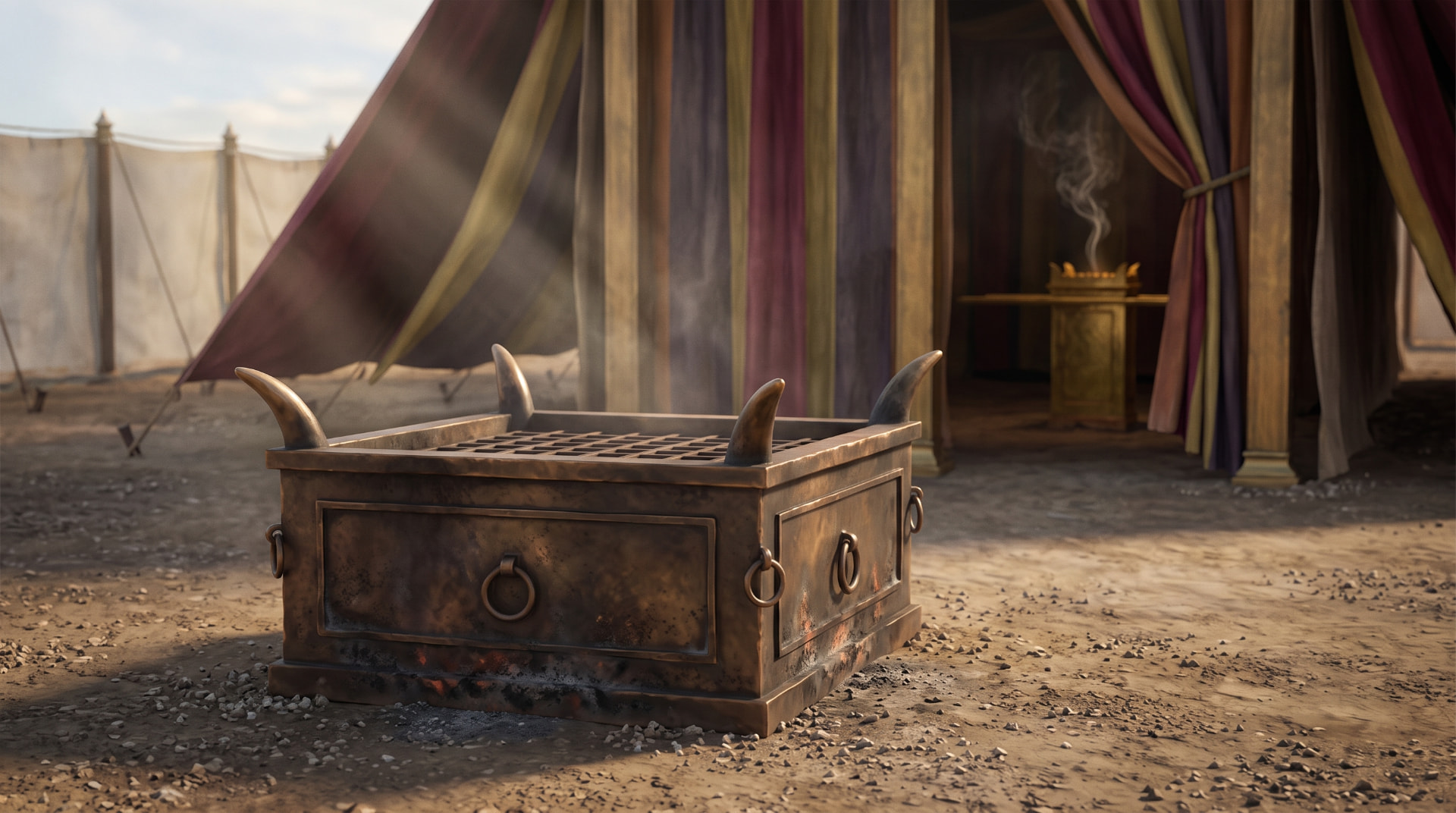
"And thou shalt make the horns of it upon the four corners thereof: his horns shall be of the same: and thou shalt overlay it with brass."
1. Introduction: The Central Question
In the architecture of the Mosaic tabernacle, two distinct altars were appointed for worship: the bronze altar of burnt offering in the outer court and the golden altar of incense in the Holy Place. Both structures featured four projections at their upper corners designated as "horns" (qĕrānôt).
What did the altar horns signify within Israel’s worship and law, and how does the Bible’s later language of refuge and salvation develop that imagery?
Scripture nowhere provides an abstract definition of the horns; rather, it discloses their significance through what was commanded and performed at them. This study traces that significance across the canon: from the physical construction and blood rituals of the tabernacle altars, through the legal boundaries of asylum and prophetic indictments of apostasy, to Davidic promises of divine power, heavenly judgment, and eternal refuge in Christ.
Key to Evidentiary Labels
- Direct Statement: What a biblical text explicitly asserts.
- Typology: A redemptive-historical pattern established in the Old Testament and fulfilled in the New Testament.
- Possible Echo: A suggestive resonance that enriches a reading without being explicitly asserted by the text.
- Study Observation: A thematic connection or contrast the study draws that neither text directly asserts on its own.
2. The Altars and Their Horns: Construction, Materials, and Placement
The tabernacle instructions given to Moses on Mount Sinai specified two distinct altars. For each structure, the horns were not separate attachments, but were fashioned of the same wood as the body ("his horns shall be of the same"), rising directly from the four upper corners before receiving their metal overlay (Direct Statement).
| Feature | The Altar of Burnt Offering | The Altar of Incense |
|---|---|---|
| Biblical Passage | Exodus 27:1–8; 38:1–7 | Exodus 30:1–10; 37:25–28 |
| Location | Outer court, before the tabernacle door | Holy Place, before the inner veil |
| Dimensions | 5 cubits long × 5 cubits broad × 3 cubits high | 1 cubit long × 1 cubit broad × 2 cubits high |
| Body and Horns | Acacia wood overlaid with brass (bronze) | Acacia wood overlaid with pure gold |
| Primary Rite | Daily animal sacrifices and burnt offerings | Perpetual morning and evening incense |
Exodus 30:7–9 reserves the golden altar for incense, expressly forbidding burnt, meat, and drink offerings upon it.
3. Blood on the Horns: Purification and Consecration
The horns served as the designated point of contact for sacrificial blood in specific rites of consecration and purification. In ordinary burnt offerings, the blood was simply sprinkled round about upon the altar (Leviticus 1:5). At the initial consecration of the sanctuary, Moses took the blood of the bullock and "put it upon the horns of the altar round about with his finger, and purified the altar, and poured the blood at the bottom of the altar, and sanctified it, to make reconciliation upon it" (Leviticus 8:15; cf. Exodus 29:12) (Direct Statement).
The Graduated Sin Offerings of Leviticus 4
In Leviticus 4, the ritual treatment of the blood of the sin offering (ḥaṭṭāʾt) depends upon the covenantal responsibility of the party on whose behalf it was offered:
- The Anointed Priest and the Whole Congregation: When the high priest or the entire assembly committed an unintentional trespass, blood was carried into the Holy Place. The priest sprinkled blood seven times before the veil and smeared it "upon the horns of the altar of sweet incense before the LORD" (Leviticus 4:7; cf. 4:18), pouring the remainder at the base of the outer bronze altar (Direct Statement).
- A Ruler or a Common Person: When a civil ruler (Leviticus 4:22–26) or an individual member of the covenant community (4:27–35) sinned, the blood remained in the court. The priest placed the blood directly "upon the horns of the altar of burnt offering" with his finger (4:25, 30, 34) and poured out the rest at the bottom of that same altar (Direct Statement).
The Day of Atonement (Leviticus 16:18–19)
On the annual Day of Atonement (Yom Kippur), after making reconciliation in the Most Holy Place, the high priest performed a purifying rite upon the altar:
"And he shall go out unto the altar that is before the LORD, and make an atonement for it; and shall take of the blood of the bullock, and of the blood of the goat, and put it upon the horns of the altar round about. And he shall sprinkle of the blood upon it with his finger seven times, and cleanse it, and hallow it from the uncleanness of the children of Israel."
The text permits two internal canonical readings regarding the phrase "the altar that is before the LORD":
- The Golden Incense Altar: This reading finds direct support in Exodus 30:10, which explicitly mandates an annual Day of Atonement cleansing upon its horns: "And Aaron shall make an atonement upon the horns of it once in a year with the blood of the sin offering of atonements." Furthermore, Leviticus 4:18 explicitly uses this exact designation for the golden altar inside the tent: "the altar which is before the LORD, that is in the tabernacle of the congregation" (cf. Leviticus 4:7).
- The Outer Bronze Altar: The alternative reading looks to the narrative progression in Leviticus 16:20, which summarizes the cleansing as moving from the holy place (Most Holy Place), to the tabernacle of the congregation (Holy Place), and finally to "the altar"—reading this sequence as Aaron's outward movement into the court to cleanse the bronze altar.
In either reading, verse 19 defines the theological purpose of the rite: the blood applied to the horns cleansed (ṭiharô) and hallowed (qiddašô) the altar from the uncleanness of the children of Israel (Direct Statement).
4. The Altar as a Place of Refuge—and the Limit of That Refuge
Because the altar was holy unto the LORD, it served in Israelite practice as a place of asylum. A person whose life was in immediate peril could flee to the sacred court and grasp the horns of the altar, appealing to divine mercy. However, Mosaic legislation set an explicit legal boundary on this protection.
The Law of Homicide (Exodus 21:12–14)
The civil statutes delivered at Sinai distinguished between unintentional manslaughter and premeditated murder:
"He that smiteth a man, so that he die, shall be surely put to death. And if a man lie not in wait, but God deliver him into his hand; then I will appoint thee a place whither he shall flee. But if a man come presumptuously upon his neighbour, to slay him with guile; thou shalt take him from mine altar, that he may die."
While the accidental killer could find safety from the avenger of blood in the cities of refuge (Numbers 35:9–15; Deuteronomy 19:1–13), the deliberate murderer was to be taken even from the altar, "that he may die" (Direct Statement).
Historical Cases: Adonijah and Joab
First Kings records two narrative accounts of men grasping the altar horns under very different circumstances:
- Adonijah (1 Kings 1:50–53): Following the public anointing of Solomon, Adonijah feared execution for his failed attempt to usurp the throne. He fled to the tabernacle and caught hold of the altar horns, pleading for his life. Because his offense was political rather than the bloodguilt of murder, Solomon granted him conditional clemency: "If he will shew himself a worthy man, there shall not an hair of him fall to the earth: but if wickedness shall be found in him, he shall die" (1:52). Adonijah was brought down from the altar and spared. Later, when he petitioned for Abishag, Solomon judged that Adonijah had "spoken this word against his own life" (1 Kings 2:23), recalling the condition of 1:52, and ordered his execution (2:24–25) (Direct Statement).
- Joab (1 Kings 2:28–34): When Joab fled to the tabernacle and caught hold of the horns, he refused Benaiah's order to come forth, declaring, "Nay; but I will die here" (2:30). Solomon ordered him struck down at the altar. Solomon's action is consistent with Exodus 21:14; 1 Kings explains it through Joab’s unpunished bloodguilt in the cold-blooded assassinations of Abner and Amasa during peacetime (1 Kings 2:5–6, 31–33) (Direct Statement).
5. Sin Engraved on the Horns: Jeremiah’s Indictment
Centuries later, Jeremiah wrote:
"The sin of Judah is written with a pen of iron, and with the point of a diamond: it is graven upon the table of their heart, and upon the horns of your altars; Whilst their children remember their altars and their groves by the green trees upon the high hills."
Jeremiah indicts Judah’s persistent idolatry, including its altars and high-place practices (Jeremiah 17:1–2; cf. 7:8–11) (Direct Statement). Drawing on the language of stone engraving—using a "pen of iron" (ʿēṭ barzel) with the "point of a diamond" (šāmîr)—the prophet depicts their sin as carved permanently into two places: the inner table of their heart and the horns of their altars.
This imagery forms a sharp canonical contrast with the Levitical law. In Leviticus 4:25, the priest placed the blood of the sin offering upon the horns of the altar to make atonement (Direct Statement). In Jeremiah 17:1, the horns bear not the cleansing mark of sacrificial blood, but the indelible inscription of the people's transgression (Direct Statement). As a study observation, the very horns appointed to receive atonement blood are presented instead as bearing the permanent record of apostasy (Study Observation).
A parallel judgment is announced against the northern kingdom: "I will also visit the altars of Bethel: and the horns of the altar shall be cut off, and fall to the ground" (Amos 3:14) (Direct Statement). The very place where blood was applied and mercy sought is itself struck down.
6. The "Horn of Salvation": Divine Strength, the Arm of the LORD, and the Davidic Promise
In the poetic and prophetic books of the Old Testament, the word "horn" (qeren) frequently appears as an independent metaphor for strength, dignity, and victory, drawn from the natural image of an animal lifting its head in triumph (Deuteronomy 33:17; Psalm 75:10).
The Horn and the Mighty Arm in the Davidic Tradition
Scripture applies this imagery to God's saving power and the rule of His anointed king:
- David celebrates God's deliverance: "The LORD is my rock, and my fortress, and my deliverer; my God, my strength, in whom I will trust; my buckler, and the horn of my salvation, and my high tower" (Psalm 18:2; cf. 2 Samuel 22:3) (Direct Statement).
- In Psalm 89, the exaltation of the horn is set beside the mighty arm of God: "Thou hast a mighty arm: strong is thy hand, and high is thy right hand" (89:13), followed by, "For thou art the glory of their strength: and in thy favour our horn shall be exalted" (89:17; cf. 89:21, 24; 132:17) (Direct Statement).
The Benedictus: Luke 1:68–71
This association between the divine arm and saving strength reemerges in the opening chapter of the New Testament. In Mary's Magnificat, God's power is celebrated: "He hath shewed strength with his arm; he hath scattered the proud in the imagination of their hearts" (Luke 1:51). Later in the same chapter, when Zechariah is filled with the Holy Ghost, he proclaims:
"Blessed be the Lord God of Israel; for he hath visited and redeemed his people, And hath raised up an horn of salvation for us in the house of his servant David; As he spake by the mouth of his holy prophets, which have been since the world began: That we should be saved from our enemies, and from the hand of all that hate us."
Earlier in the chapter, the angel Gabriel announced to Mary that her child "shall be called the Son of the Highest: and the Lord God shall give unto him the throne of his father David" (Luke 1:32–33), having established that Joseph was "of the house of David" (1:27) (Direct Statement). Through this shared verbal link to the "house of David," Zechariah’s announcement of a "horn of salvation" (keras sōtērias) in David's house points to the arriving child Jesus as that promised deliverer (Study Observation).
Furthermore, Psalm 118 brings saving strength and the altar into one composition: "The LORD is my strength and song, and is become my salvation" (118:14), and later, "bind the sacrifice with cords, even unto the horns of the altar" (118:27). The New Testament explicitly applies Psalm 118 to Jesus, citing both verse 22 ("The stone which the builders refused is become the head stone of the corner", Matthew 21:42) and verse 26 ("Blessed is he that cometh in the name of the LORD", Matthew 21:9) (Direct Statement). Luke does not cite verse 27 or identify Jesus with the altar horns, and the text gives no more than a resonance: the priest who had just ministered at the golden altar of incense announces the Davidic deliverer who brings salvation and the remission of sins (Luke 1:8–11, 69, 77) (Possible Echo).
7. The Heavenly Altar and Refuge in Christ
The New Testament returns to altar imagery and the language of refuge in Revelation and Hebrews.
The Voice from the Horns in Revelation 9:13
Under the sounding of the trumpets, the heavenly sanctuary appears before the throne:
"And the sixth angel sounded, and I heard a voice from the four horns of the golden altar which is before God, Saying to the sixth angel which had the trumpet, Loose the four angels which are bound in the great river Euphrates."
In Revelation 8:3–5, the golden altar is the place where the prayers of the saints are offered with incense before God. In Revelation 9:13, the command for judgment issues from the four horns of that same altar of intercession (Direct Statement). The passage does not identify Christ as the altar; rather, it presents the heavenly counterpart of sanctuary worship.
Fleeing for Refuge: Hebrews 6:18 and the True Altar
The Epistle to the Hebrews describes the security believers possess in God's sworn promise:
"That by two immutable things, in which it was impossible for God to lie, we might have a strong consolation, who have fled for refuge to lay hold upon the hope set before us: Which hope we have as an anchor of the soul, both sure and stedfast, and which entereth into that within the veil; Whither the forerunner is for us entered, even Jesus, made an high priest for ever after the order of Melchisedec."
The phrase "who have fled for refuge to lay hold upon the hope set before us" echoes the legal provision of the Old Testament cities of refuge, where the manslayer fled for protection (Numbers 35:11–15; Joshua 20:1–6). The action of fleeing to lay hold of hope may also carry a suggestive resonance with suppliants seeking sanctuary at the altar (Possible Echo).
Yet Hebrews points beyond earthly structures: "We have an altar, whereof they have no right to eat which serve the tabernacle" (Hebrews 13:10). As the bodies of those beasts whose blood was brought into the sanctuary for sin were burned without the camp on the Day of Atonement (Leviticus 16:27; Hebrews 13:11), so "Wherefore Jesus also, that he might sanctify the people with his own blood, suffered without the gate" (Hebrews 13:12) (Typology). The hope of the believer is anchored "within the veil," where Jesus ministers as an eternal High Priest after the order of Melchizedek (Hebrews 6:19–20). Animal sacrifices could never make the worshipper perfect as pertaining to the conscience (Hebrews 9:9; 10:4). In Christ, the believer finds enduring forgiveness and access to the presence of God.
8. Canonical Synthesis
| Canonical Passage | Biblical Context | Altar / Horn Imagery | Evidentiary Warrant |
|---|---|---|---|
| Exodus 27:1–2; 30:1–3 | Tabernacle instructions at Sinai | Four horns formed of one piece with the bronze and golden altars. | Direct Statement |
| Leviticus 4:7, 25; 16:18–19 | Sin offerings and Day of Atonement | Sacrificial blood applied with the finger to the horns of the altars. | Direct Statement |
| Exodus 21:12–14; 1 Kings 1–2 | Law of homicide; cases of Adonijah and Joab | Grasping the horns of the bronze altar for personal asylum. | Direct Statement |
| Jeremiah 17:1–2; Amos 3:14 | Prophetic indictment: Jer 17:1–2 (Judah); Amos 3:14 (Bethel) | Sin engraved on Judah's altars; the horns of Bethel cut off. | Direct Statement (texts) / Study Observation (contrast) |
| Psalm 18:2; 89:13, 17; Luke 1:27, 32–33, 51, 68–71 | Davidic praise; Zechariah's Benedictus | God's mighty arm and right hand; the "horn of salvation" in David's house. | Direct Statement (texts) / Study Observation (identification) |
| Psalm 118:14, 27; Luke 1:8–11, 69, 77 | Sanctuary worship; Zechariah at the incense altar | Consecrated sacrifice at the horns; Zechariah announcing the horn of salvation. | Possible Echo |
| Revelation 9:13–14 | Sixth trumpet judgment | A voice commanding judgment from the four horns of the golden altar. | Direct Statement |
| Hebrews 6:18–20; 13:10–12 | Hope within the veil; Hebrews’ altar and sacrifice | Fleeing for refuge; our altar; Christ’s sanctifying sacrifice. | Possible Echo (Heb 6) / Typology (Heb 13) |
9. Conclusion
The central question of what the altar horns signified finds its resolution not in an abstract definition, but in the canonical movement from the earthly sanctuary to Jesus Christ. Scripture reveals their meaning through what was performed at them: they were the elevated places of consecration, blood atonement, and urgent appeals for life. Across this progression, the altar horns gather three themes: God-given power, atonement, and refuge.
In the New Testament, these themes culminate in Christ. He is the Davidic horn of salvation (Luke 1:69). Entering the true heavenly sanctuary, "into heaven itself" (Hebrews 9:24), "by his own blood," He has obtained "eternal redemption" (Hebrews 9:12). All who flee to Him find an anchor of hope within the veil, where He "ever liveth to make intercession for them" (Hebrews 7:25).
A horn of salvation. A promise of deliverance. A trail of symbols woven through Scripture. Where does it lead? Follow it in No Other Beside Me.