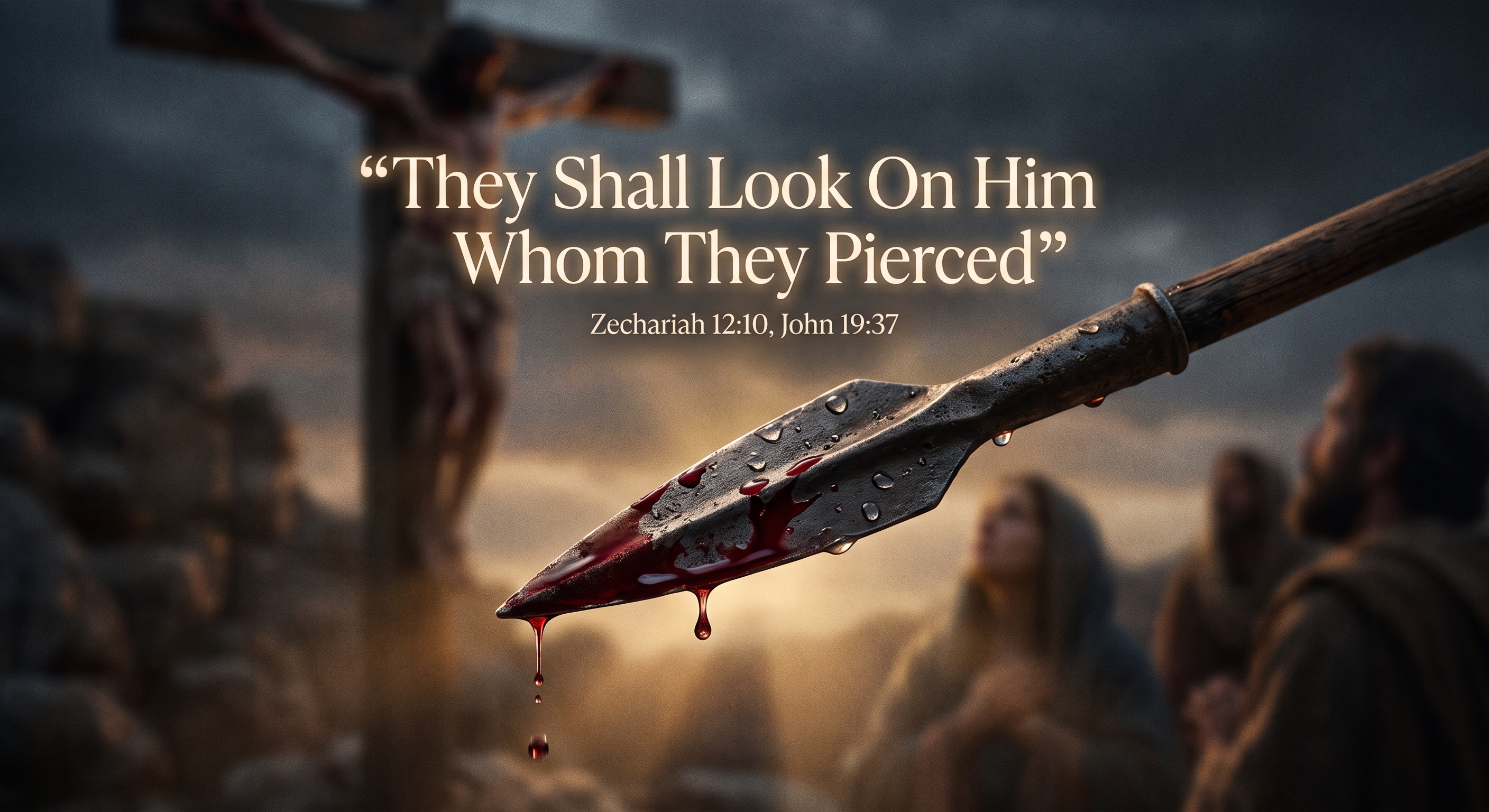
Zechariah 12:10, John 19:37, and the Pierced Shepherd
“And again another scripture saith, They shall look on him whom they pierced.”
The Pierced Side
Jesus was already dead when the soldiers came to Him. They broke the legs of the men crucified beside Him, but His they left intact. Instead, a soldier drove a spear into His side, and immediately blood and water flowed forth.
John pauses over what he has witnessed. “He that saw it bare record,” he writes, “and his record is true” (John 19:35). He then places the scene beneath two Scriptures. The first concerns the bones that remained unbroken; the second fastens directly upon the piercing: “They shall look on him whom they pierced” (John 19:37).
The citation is from Zechariah 12:10. John has not selected a general prophecy of suffering. He has reached into a passage where YHWH speaks in the first person.
“They Shall Look Upon Me”
Zechariah 12 opens as “the word of the LORD for Israel.” The speaker identifies Himself as the one “which stretcheth forth the heavens, and layeth the foundation of the earth, and formeth the spirit of man within him” (Zech 12:1). The voice throughout the chapter remains unmistakably that of the Creator. It is YHWH who makes Jerusalem “a cup of trembling” and “a burdensome stone” to the surrounding peoples (Zech 12:2–3); it is YHWH who strikes the horses with blindness (Zech 12:4), defends the inhabitants of the city (Zech 12:8), and determines to destroy the besieging nations (Zech 12:9).
Then follows the declaration:
“And I will pour upon the house of David, and upon the inhabitants of Jerusalem, the spirit of grace and of supplications: and they shall look upon me whom they have pierced, and they shall mourn for him, as one mourneth for his only son.”
The movement of the Hebrew text is stark. YHWH speaks: “I will pour.” The same first-person subject continues: “they shall look upon me [ʾēlay] whom they have pierced.” Yet within the same verse, the sentence shifts to the third person: “and they shall mourn for him.”
Whatever syntactical questions this transition raises, the identity of the speaker at the outset remains clear. The God who stretched forth the heavens declares that the people will look upon “me whom they have pierced.”
John’s Citation at the Cross
John records the prophecy in the third person: “They shall look on him whom they pierced” (John 19:37). While the pronoun aligns with the mourning clause of Zechariah 12:10, its referent within the Gospel narrative is unmistakable. The one pierced is Jesus of Nazareth.
This is where the citation exerts its theological force. John is not registering a superficial parallel. He has just described the spear opening the side of Jesus and immediately places Zechariah’s words over the wounded Christ. The question arises naturally: if Zechariah records YHWH declaring, “they shall look upon me whom they have pierced,” what is John doing when he applies those words to Jesus?
The Evangelist offers no extended explanation. He places the prophetic text beside the event and allows the correspondence to stand.
The Fountain Opened
In Zechariah, lamentation does not have the final word. Immediately following the mourning in chapter 12, another promise appears:
“In that day there shall be a fountain opened to the house of David and to the inhabitants of Jerusalem for sin and for uncleanness.”
The sequence is clear: the pierced one is beheld, the land mourns, and a fountain is opened for cleansing. John’s passion account presents an analogous sequence. Jesus is pierced; blood and water emerge from His side; the Evangelist bears witness to what he has seen; and Zechariah 12:10 is invoked.
John does not explicitly identify the blood and water with Zechariah’s cleansing fountain. In Zechariah, the promise of cleansing follows the piercing and mourning. In John, blood and water flow from the wound of the Crucified.
“Awake, O Sword, Against My Shepherd”
Later in the same prophetic sequence, YHWH commands the sword to rise against His shepherd:
“Awake, O sword, against my shepherd, and against the man that is my fellow, saith the LORD of hosts: smite the shepherd, and the sheep shall be scattered.”
The terminology carries unusual weight. The shepherd is designated by YHWH as “my shepherd” and “the man that is my fellow” (geber ʿămîtî), a term denoting a fellow or one standing in close relation.
On the night of His betrayal, Jesus takes this Scripture upon His own lips:
“All ye shall be offended because of me this night: for it is written, I will smite the shepherd, and the sheep of the flock shall be scattered abroad.”
Jesus reads His approaching arrest and the scattering of His disciples through Zechariah’s words. The prophetic lines of Zechariah 12 and 13 therefore meet in the passion narratives. Before the cross, Jesus identifies His approaching fate with that of YHWH’s shepherd; at the cross, John identifies the wounded Jesus with the pierced figure of Zechariah 12:10.
Zechariah distinguishes the first-person speaker of Zechariah 12:10 from “my shepherd” in Zechariah 13:7. Yet the New Testament brings both passages into the passion of the same Jesus. The distinction remains, even as both texts converge upon Him.
Every Eye Shall See Him
The pierced one appears again at the opening of Revelation:
“Behold, he cometh with clouds; and every eye shall see him, and they also which pierced him: and all kindreds of the earth shall wail because of him.”
Two prophetic streams meet in this vision. The figure coming “with clouds” recalls the “one like the Son of man” who comes with the clouds of heaven in Daniel 7:13, while the beholding of the pierced one and the mourning of the peoples recall Zechariah 12:10.
The crucified Christ of John 19 is not left at Golgotha. Revelation takes the pierced figure and places Him within the scene of His appearing. The sight once confined to those gathered at the cross expands to universal scope: “every eye shall see him.”
The wound remains part of His identity. The one who comes with the clouds is the one who was pierced. Humiliation and glory belong to the same subject.
The One Who Speaks and the One Who Is Seen
Zechariah presents the struck shepherd as YHWH’s fellow and records the divine voice anticipating His own piercing. The Gospel brings both prophetic lines into the passion of Jesus: He identifies His approaching fate with that of the shepherd who is struck, and John places Zechariah’s words concerning the pierced one over His wounded body.
From the first-person voice of YHWH in Zechariah, to the body of Jesus at Golgotha, to the glorified figure whom every eye will see, Scripture keeps the same wound in view. The one once looked upon in humiliation will be seen again in glory.