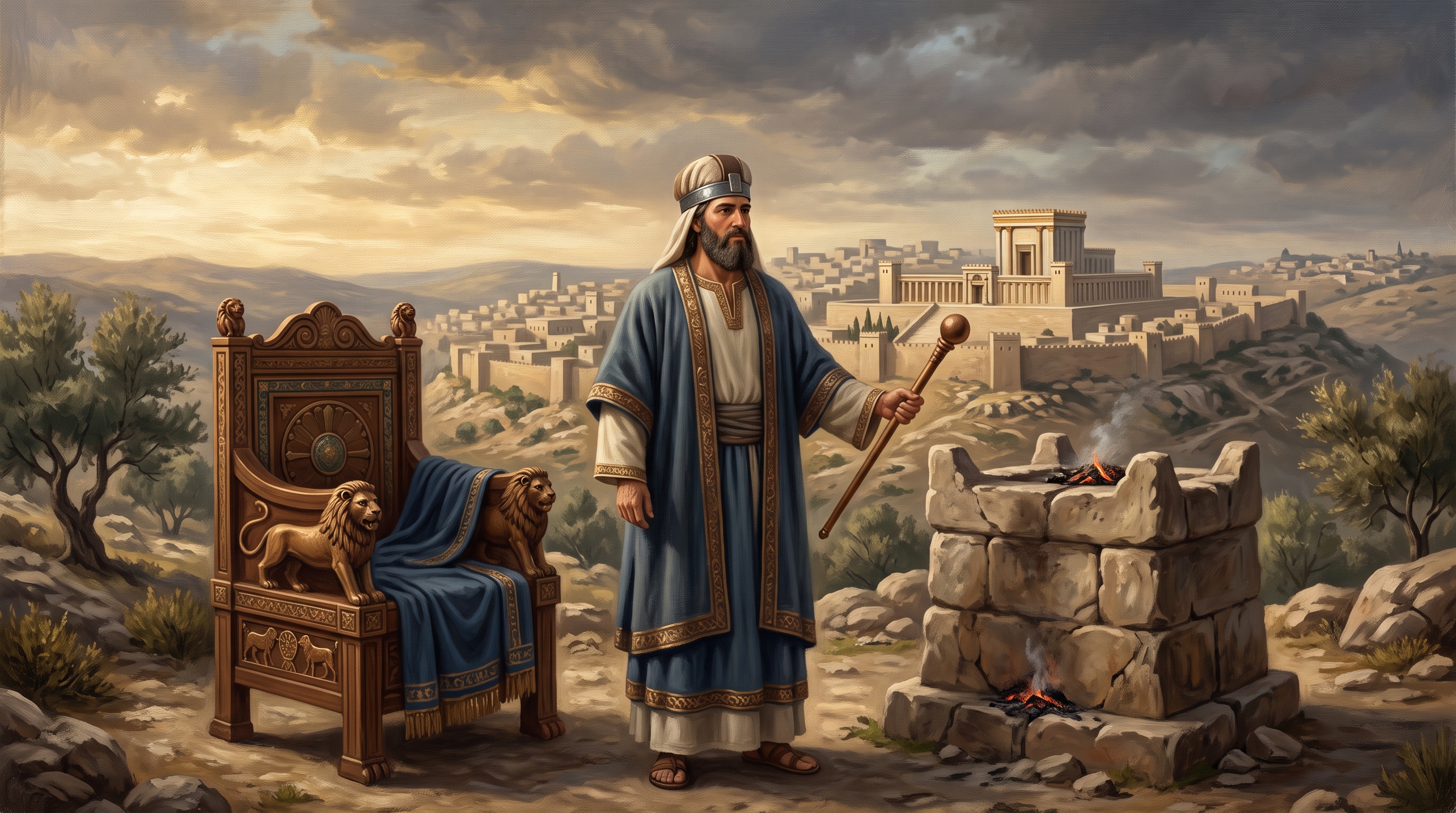
Psalm 110:1–4 as the Axis of King and Priest
“The Lord said unto my Lord, Sit thou at my right hand, until I make thine enemies thy footstool... The Lord hath sworn, and will not repent, Thou art a priest for ever after the order of Melchizedek.”
— Ps 110:1, 4
Within the architecture of Old Testament prophecy, few texts exert so definitive an authority over apostolic Christology as Psalm 110. It is a text not merely cited, but embedded within the broader witness of the New Testament. At its center lies an extraordinary junction: God directs two solemn declarations to a single Davidic figure. In the first, this figure is summoned to the seat of honor at God’s right hand; in the second, he is consecrated into an enduring priesthood entirely distinct from the Aaronic line.
Under Mosaic law, the scepter of civil authority and the altar of priestly mediation were kept strictly separate. Psalm 110 envisions the bringing together of these two distinct callings in one figure. Tracing that resolution requires following the movement of the psalm itself, examining its patriarchal background in Genesis 14, noting the sectarian perspectives of the Second Temple era, and observing how apostolic writers—most extensively the author of Hebrews—integrate royal session, priestly mediation, and the subjugation of enemies into a singular, cohesive scriptural testimony.
The Movement of Psalm 110: Scepter and Priesthood United
In verse 1, David overhears the summons: “The Lord said unto my Lord, Sit thou at my right hand, until I make thine enemies thy footstool.” The Hebrew address rendered “my Lord” (adoni) denotes a master, ruler, or acknowledged superior. While the title does not in itself define the ontological nature of the figure, it establishes that David recognizes one whose station transcends his own. The invitation to sit at God’s right hand signifies supreme preeminence, judicial honor, and delegated royal authority.
The clause “until I make thine enemies thy footstool” indicates a reign that begins and advances in the presence of active resistance. The Davidic ruler’s strength goes forth from Zion as he executes authority “in the midst of [his] enemies” (v. 2).
In verse 4, the divine voice addresses the same figure: “The Lord hath sworn, and will not repent, Thou art a priest for ever after the order of Melchizedek.” The affirmation that the Lord “will not repent” marks this appointment as permanent and unconditional.
This strict boundary had been absolute under the Mosaic economy—demonstrated when King Uzziah was struck with leprosy for encroaching upon the sanctuary to burn incense (2 Chr 26:16–21). In Psalm 110, however, the very figure seated at God’s right hand is addressed as an eternal priest. In apostolic exegesis, this convergence dismantles the former institutional division: the ruler’s priestly legitimacy rests not on genealogical descent from Levi, but on the enduring pattern of Melchizedek.
The Melchizedek Pattern: Genesis 14
To understand the reference to Melchizedek, the inquiry turns back to Genesis 14:18–20. Following the rescue of Lot, Melchizedek, king of Salem, meets Abram in the valley of Shaveh, bringing forth bread and wine. The text records that “he was the priest of the most high God.” Melchizedek blesses Abram, and Abram renders him a tenth of all.
Three distinct features shape the canonical significance of this encounter:
-
Melchizedek embodies both royal rule and priestly ministry centuries before the Levitical cultus is instituted.
-
Abram, the progenitor of the covenant people, receives Melchizedek’s blessing and yields tithes to him.
-
Melchizedek appears without ancestral documentation, entering and leaving the inspired record solely in his royal and priestly capacity.
Hebrews draws out the meaning of his name as “king of righteousness” and his title as “king of peace” (Heb 7:2). In the Genesis narrative, these designations reinforce a scriptural type whose theological substance rests upon Abram’s submission and the unique, unpartitioned nature of Melchizedek’s office.
Psalm 110:4 recalls this historical figure to establish a distinct priestly order. The Hebrew phrase ʿal-dibrati has traditionally been translated “after the order of,” though it is also rendered “according to the manner of” or “after the likeness of.” The New Testament does not present the Davidic ruler as an earthly descendant of Melchizedek; rather, his ministry reflects an office that stands outside tribal descent, united with royal rule and ratified by God.
Second Temple Context: Sectarian Expectations and Qumran
During the Second Temple period, Jewish communities reflected deeply on the restoration of Israel, the sanctuary, and the promises given to David. These expectations were neither monolithic nor unified.
The Dead Sea Scrolls preserve one clear sectarian model. The Rule of the Community (1QS IX, 11) anticipates a future order marked by “the Prophet and the anointed ones of Aaron and Israel.” This points to an expectation within that community of divided leadership between a priestly messiah and a royal messiah. The Rule of the Congregation (1QSa II, 11–22) depicts a messianic banquet governed by this same division: the priest takes precedence, blessing the bread and wine before the Messiah of Israel.
Other sectarian writings preserve alternative traditions. In the fragmentary text 11QMelchizedek (11Q13 II, 1–25), Melchizedek appears in an exalted role associated with heavenly judgment and the proclamation of jubilee, though his exact identity remains an object of modern scholarly debate.
These texts show that the Qumran community maintained a clear distinction between priestly and royal leadership. The apostolic proclamation, however, recognized a different reality. In Jesus, the two pronouncements of Psalm 110 converge: the royal scepter and the priesthood are united without division or rivalry in the person of the exalted Messiah.
The Apostolic Exegesis: Jesus, Peter, and the Exalted Lord
The New Testament reads Psalm 110 through the lens of Jesus’ ministry, bodily resurrection, and heavenly ascension.
The Question of David’s Lord (Matt 22:41–46; Mark 12:35–37; Luke 20:41–44)
In the temple courts, Jesus confronts the Pharisees regarding the identity of the Messiah:
“How then doth David in spirit call him Lord, saying, The Lord said unto my Lord, Sit thou on my right hand, till I make thine enemies thy footstool? If David then call him Lord, how is he his son?”
Jesus fixes upon the tension in David’s opening words: the monarch acknowledges his own promised descendant as his superior. The passage does not deny Jesus’ Davidic lineage, but it shows that biological descent alone cannot explain the Messiah’s status. The apostolic proclamation provides the canonical answer: David’s descendant is David’s Lord because he is exalted to the right hand of the Majesty on high.
Exaltation and Vindication (Acts 2:29–36)
On the Day of Pentecost, Peter applies Psalm 110:1 directly to the risen Jesus:
“For David is not ascended into the heavens: but he saith himself, The Lord said unto my Lord, Sit thou on my right hand, Until I make thy foes thy footstool. Therefore let all the house of Israel know assuredly, that God hath made that same Jesus, whom ye have crucified, both Lord and Christ.”
Peter points out that David remained in his tomb and did not ascend to the right hand of God. Citing God’s covenant promise that one of David’s seed would sit upon his throne (Acts 2:29–33), Peter identifies the resurrection and ascension as the definitive act of divine vindication. God has manifested the crucified Jesus through this exaltation, making him both Lord and Christ.
The Argument of Hebrews: The Melchizedekian Precedent
While the Gospels and Acts cite Psalm 110:1 to establish Christ’s royal enthronement, Hebrews makes verse 4 the cornerstone of its priestly exposition (Heb 5:6; 6:20; 7:17, 21).
The Problem of Ancestry (Heb 7:11–14)
Hebrews directly confronts the statutory limitation of the Mosaic order: “For it is evident that our Lord sprang out of Juda; of which tribe Moses spake nothing concerning priesthood” (Heb 7:14). Under the Sinai legislation, sanctuary administration belonged exclusively to Aaron’s lineage within the tribe of Levi.
Hebrews argues that Psalm 110:4 anticipated the provisional nature of that economy:
“If therefore perfection were by the Levitical priesthood... what further need was there that another priest should rise after the order of Melchisedec, and not be called after the order of Aaron?”
— Heb 7:11
Because the psalm postdates the giving of the law, its decree reveals that the Levitical system was never the ultimate foundation for priestly mediation.
The Presentation of Melchizedek in Genesis (Heb 7:1–3)
The epistle examines the specific literary portrait given in Genesis: Melchizedek appears “without father, without mother, without descent, having neither beginning of days, nor end of life” (v. 3). Genesis records no pedigree, succession, or death for him.
Hebrews grounds its typological argument upon this textual presentation, observing that Melchizedek was “made like unto the Son of God” (v. 3). Melchizedek functions as a prophetic type pointing forward to Christ, whose priestly office is free from ancestral prerequisites and cannot be severed by mortality.
The Transformation of Priesthood (Heb 7:12, 16, 18–22)
Hebrews links this appointment to a necessary transformation in the law governing priestly office: “For the priesthood being changed, there is made of necessity a change also of the law” (Heb 7:12).
Levitical priests entered office by hereditary statute. This Priest, however, is appointed by divine declaration: “The Lord sware and will not repent, Thou art a priest for ever after the order of Melchisedec” (v. 21). Operating through “the power of an endless life” (v. 16), his office is untransferable. The former commandment governing priestly appointment gives way to an enduring order, establishing Jesus as the guarantor of a better covenant (v. 22).
The Royal Rule: Subjugation of Enemies
Psalm 110:1 and 110:4 present an integrated mandate: the King-Priest governs from the right hand of God while his dominion is actively contested.
-
Reign in the Midst of Resistance: The commission confirms that Christ’s exaltation does not await a submissive world. His authority goes forth from the heavenly Zion to govern history while rebellion persists.
-
The Horizon of Subjugation: Paul applies this exact sequence in 1 Corinthians 15:25: “For he must reign, till he hath put all enemies under his feet.” Christ’s session advances toward the total eradication of all hostile powers, concluding with the defeat of death itself.
-
Judicial Vindication: Verses 5–6 present an overarching scene of judgment: earthly rulers are shattered and nations are judged in the day of wrath. Whether the text depicts the Lord acting on behalf of his chosen ruler or the exalted king himself executing the decree, the psalm guarantees that divine justice will triumph decisively over all opposition.
The Axis of King and Priest
Where Mosaic ordinances maintained an unyielding partition between the ruler’s rod and the priest’s altar, Psalm 110 establishes their lasting convergence. By heavenly mandate, God concentrated royal dominion and an eternal priesthood in a single Davidic figure.
In the apostolic testimony, this union is realized in the risen and ascended Christ. He is David’s Lord, the eternal Priest after the order of Melchizedek, exercising delegated authority at the Father’s right hand until every enemy is made his footstool.
Dead Sea Scrolls citations and translations follow Florentino García Martínez and Eibert J. C. Tigchelaar, eds., The Dead Sea Scrolls Study Edition, 2 vols. (Leiden: Brill, 1997–1998).
How does the apostolic witness proclaim this exalted priest-king while fiercely guarding Israel’s confession that YHWH is one? Explore the biblical architecture in No Other Beside Me.