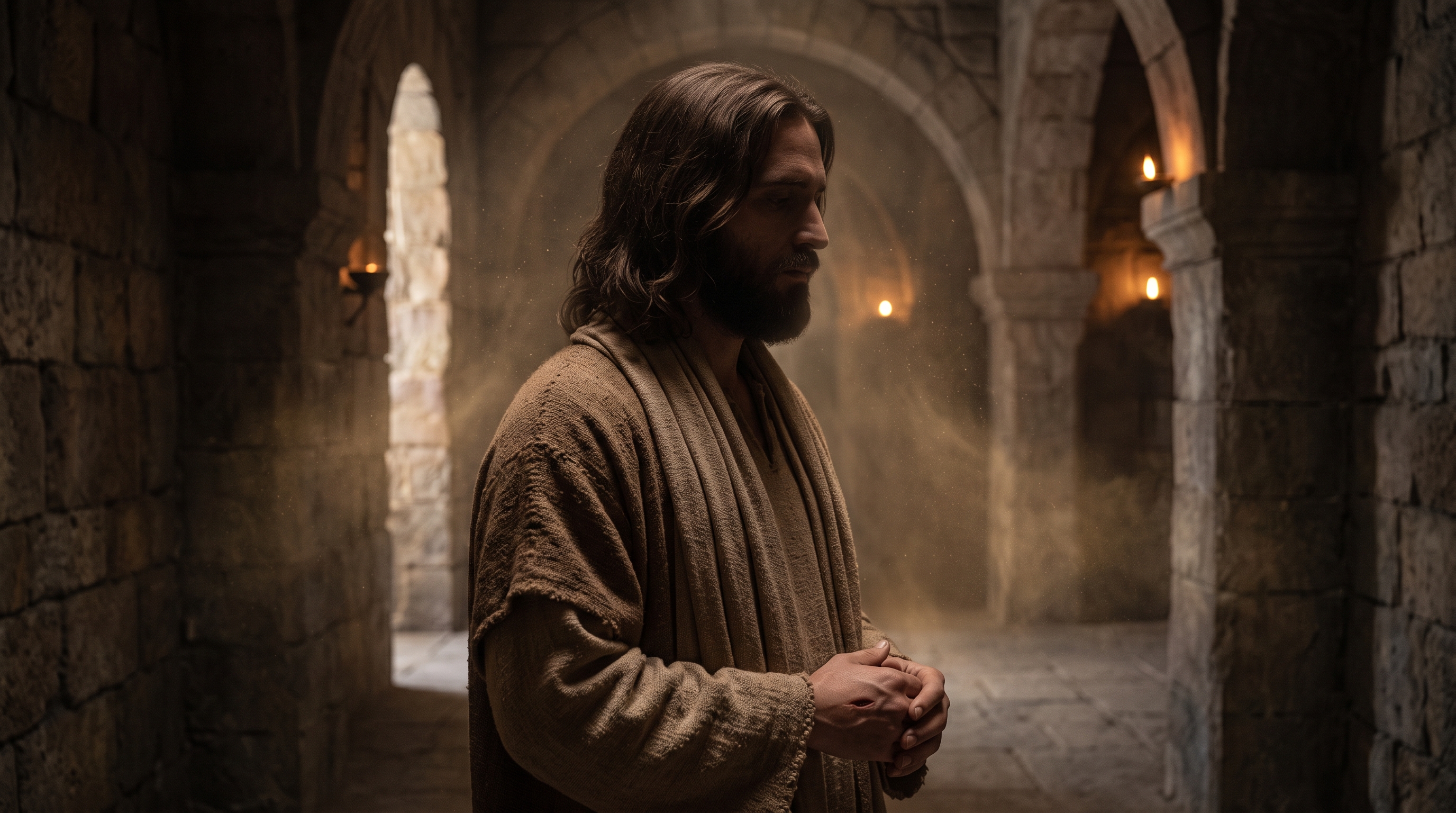
Embodiment, Divine Spirit, and the Risen Christ in the New Testament
“Now the Lord is the Spirit, and where the Spirit of the Lord is, there is freedom.”
Introduction
The New Testament speaks of Jesus Christ in ways that resist a simple opposition between embodiment and Spirit. The Word becomes flesh. Jesus suffers, dies, rises, speaks, eats, and can be touched. When His disciples suppose that they are seeing a spirit after the resurrection, He directs them to the reality of His own body (Luke 24:37–39). The risen Christ is not a phantom. The one who stands before them is the same Jesus who was crucified.
Yet this is not the only language the apostolic witness uses. Paul writes that “the last Adam became a life-giving spirit” (1 Cor 15:45). He speaks of the “Spirit of God,” the “Spirit of Christ,” and Christ Himself dwelling within believers (Rom 8:9–11). Elsewhere he speaks of “the Spirit of Jesus Christ” (Phil 1:19) and “the Spirit of his Son” sent into the hearts of God’s people (Gal 4:6). Most strikingly, while interpreting Moses and the veil, Paul writes: “Now the Lord is the Spirit” (2 Cor 3:17).
These statements should not be forced into categories before they are allowed to speak. Scripture does not ask whether Christ must be either a person or a spirit as though the terms belong to a single biblical opposition. It presents the embodied Jesus, the risen Lord, the life-giving Spirit, and the indwelling presence of Christ within one apostolic witness. The question, therefore, is not whether Jesus ceased to be embodied when He rose from the dead. The resurrection narratives exclude that conclusion. The deeper question is how the New Testament can speak of this same risen Christ in the language of divine Spirit.
God Is Spirit
The biblical language of Spirit begins long before the coming of Christ. From the opening words of Genesis, the Spirit of God belongs to the language of divine action. The Spirit moves over the waters as creation begins. God sends forth His Spirit and life is created; He renews the face of the ground (Ps 104:30). Through the prophets He promises to put His Spirit within His people and cause them to walk in His ways (Ezek 36:27). Spirit therefore belongs to the biblical grammar of God’s life-giving presence and activity.
The psalmist asks, “Where shall I go from your Spirit? Or where shall I flee from your presence?” (Ps 139:7). Spirit and presence stand in parallel. To flee from the Spirit of God would be to flee from God’s own presence. Isaiah remembers the Exodus in similar language. Israel rebelled and grieved YHWH’s Holy Spirit, yet the same Spirit was among them, leading them and giving them rest (Isa 63:10–14). YHWH and His Spirit can be distinguished within the language of divine action, yet the saving history remains the work of the one God who brought His people out of Egypt.
Against this biblical background Jesus declares, “God is spirit” (John 4:24). The statement occurs within a dispute about sacred place. The Samaritan woman points to Mount Gerizim, while Jerusalem represents the competing claim. Jesus directs the question beyond both. The hour is coming when worship will no longer be determined by either location. The Father seeks those who worship “in spirit and truth.” God cannot be contained by the sanctuary, nor is His presence confined to the mountain. John has already announced something equally remarkable: the God who cannot be contained by sacred geography has made Himself known within human history through the Word who became flesh.
The Word Became Flesh
John begins his Gospel before creation: “In the beginning was the Word.” All things came into being through Him. In Him was life, and that life was the light of humanity. Then the movement of the prologue reaches its astonishing declaration: “The Word became flesh and dwelt among us” (John 1:14). Divine self-disclosure enters human life. The Word does not merely appear in flesh. Jesus becomes tired. He thirsts. He weeps. He bleeds. He dies. And when He rises, He remains the one who was crucified.
Luke makes this unmistakable. When Jesus appears among His disciples after His resurrection, they are frightened because they suppose that they are seeing a spirit. Jesus answers, “See my hands and my feet, that it is I myself. Touch me, and see. For a spirit does not have flesh and bones as you see that I have” (Luke 24:39). The meaning of “spirit” in this scene is controlled by the disciples’ fear. They suppose that they are seeing an apparition. Jesus answers by presenting Himself, pointing to His hands and feet and declaring, “It is I myself.” He then eats before them.
The resurrection has not dissolved the incarnation. The one who rises is bodily continuous with the one who was crucified. This establishes an essential boundary for what follows. Whatever Paul means when he describes the risen Christ through the language of Spirit, he cannot mean that Jesus has ceased to be the embodied one who rose from the dead. Yet Paul does use that language.
The Last Adam Became a Life-Giving Spirit
First Corinthians 15 is Paul’s sustained defense of resurrection. Some among the Corinthians deny that the dead will rise, and Paul answers not by abandoning the body but by describing its transformation. What is sown perishable is raised imperishable; what is sown in dishonor is raised in glory; what is sown in weakness is raised in power; and what is sown as a “natural body” is raised as a “spiritual body” (1 Cor 15:42–44).
Paul is not contrasting a body with the absence of a body. Both remain sōma. Nor does “spiritual” require an immaterial existence. The contrast concerns the order of life to which the body belongs. The present body belongs to Adam, weakness, corruption, and mortality. The resurrection body belongs to Spirit, power, incorruption, and the age to come. Paul’s contrast is therefore not between material existence and immaterial existence, but between the life inherited from the first Adam and the new life disclosed in the last.
Paul makes this explicit by returning to Genesis: “The first man Adam became a living being”; the last Adam became “a life-giving spirit” (1 Cor 15:45). The contrast is precise. The first Adam becomes living; the last Adam becomes life-giving. Adam receives life, while Christ gives life. The first stands at the head of a humanity destined for death; the last stands at the head of a humanity destined for resurrection.
Paul does not say that the last Adam ceased to be embodied, for the entire argument concerns the resurrection of the body. The first man is “from the earth, a man of dust,” while the second man is “from heaven.” As humanity has borne the image of the man of dust, so it shall bear the image of the heavenly man (1 Cor 15:47–49).
At the center of this transformation Paul places the remarkable expression “life-giving spirit.” He does not pause to explain the phrase metaphysically. The last Adam remains the risen Christ, yet the risen Christ is now described as life-giving Spirit. The one who received life in the order of Adam has become the giver of life in the order of resurrection.
He Has Poured Out This
The movement from Jesus’ earthly ministry to His exaltation adds another dimension to the relationship between Christ and Spirit. The Gospels present Jesus as the one upon whom the Spirit rests. He is conceived through the Holy Spirit, the Spirit descends upon Him at the Jordan, He is led by the Spirit into the wilderness, and He announces His mission through Isaiah’s words: “The Spirit of the Lord is upon me” (Luke 4:18). Throughout His earthly ministry, Jesus appears as the bearer of the Spirit.
Pentecost marks a striking reversal. Peter explains the outpouring before Jerusalem through the exaltation of Jesus: “Being therefore exalted at the right hand of God, and having received from the Father the promise of the Holy Spirit, he has poured out this that you yourselves are seeing and hearing” (Acts 2:33). The one who bore the Spirit now pours out the Spirit. The one upon whom the Spirit descended has become the one through whom the promised Spirit is given.
The distinctions within the passage remain clear. Jesus is exalted, the Father gives, Christ receives, and the Spirit is poured out. Yet the movement recalls Paul’s Adamic contrast. The earthly Messiah who ministered in the power of the Spirit now stands at the head of the new creation as the giver of the Spirit.
From this point the apostolic language becomes increasingly explicit. The Spirit poured out through the exalted Christ is spoken of as the Spirit of Christ, the Spirit of Jesus Christ, and the Spirit of the Son. The risen Christ and the life-giving presence of the Spirit are brought into striking proximity.
The Lord Is the Spirit
Second Corinthians 3 brings that convergence into even sharper focus. Paul begins with Moses. When Moses descended from Sinai, the glory upon his face was such that Israel could not look steadily at him. He placed a veil over his face, removing it when he went before YHWH (Exod 34:29–35). Paul takes that scene and reads it through Christ. The veil remains when the old covenant is read, he says, “because only through Christ is it taken away” (2 Cor 3:14).
Paul then returns to the language of Exodus: “But when one turns to the Lord, the veil is removed” (2 Cor 3:16). In Exodus, Moses removes the veil when he turns before YHWH. Paul continues immediately: “Now the Lord is the Spirit, and where the Spirit of the Lord is, there is freedom” (2 Cor 3:17).
The sequence itself carries the argument. The veil is removed in Christ. One turns to the Lord. The Lord is the Spirit. Where the Spirit of the Lord is, there is freedom. Paul then speaks of beholding “the glory of the Lord” and being transformed into the same image, “from glory to glory,” from the Lord who is the Spirit (2 Cor 3:18). Exodus, Christ, Lord, Spirit, glory, and transformation now stand within the same movement.
The language retains distinction, for Paul can speak of “the Spirit of the Lord.” Yet that distinction does not prevent him from writing the preceding sentence: “The Lord is the Spirit.” The statement should not be reduced to the claim that the Lord merely gives the Spirit or acts through the Spirit. Paul’s wording is stronger than either formulation.
At the same time, the passage does not supply a later metaphysical account of how these terms relate. Paul is concerned with revelation. The veil that concealed has been removed. The glory once reflected upon the face of Moses is now encountered within the new covenant, and those who behold are themselves transformed.
The Spirit of God and the Spirit of Christ
Romans 8 carries this language into the indwelling life of the believer. Paul begins by saying, “The Spirit of God dwells in you” (Rom 8:9). Without changing the subject of indwelling life, he then writes, “Anyone who does not have the Spirit of Christ does not belong to him.” Immediately afterward the expression changes again: “But if Christ is in you” (Rom 8:10).
Paul moves through these expressions without stopping to establish boundaries between them. The Spirit of God dwells in the believer; that Spirit is spoken of as the Spirit of Christ; and Paul can describe the same indwelling context by saying that Christ is in them. The movement concludes with resurrection: “If the Spirit of him who raised Jesus from the dead dwells in you, he who raised Christ Jesus from the dead will also give life to your mortal bodies through his Spirit who dwells in you” (Rom 8:11).
Once again Spirit and life belong together. The Spirit who raised Jesus will give life to the mortal bodies of those in whom He dwells. Resurrection is therefore not escape from embodiment; mortal bodies themselves are destined for life.
Other apostolic texts speak with similar freedom. Paul refers to “the Spirit of Jesus Christ” (Phil 1:19). God sends “the Spirit of his Son into our hearts” (Gal 4:6). Luke can speak within the same missionary narrative first of the “Holy Spirit” and then of the “Spirit of Jesus” in the Greek text (Acts 16:6–7). These expressions need not be made identical in every respect to recognize their remarkable proximity. The Spirit belongs to God, the Spirit belongs to Christ, and where the Spirit dwells, Christ is in His people.
I Will Come to You
John gives this pattern its own form in the Farewell Discourse. Jesus is preparing His disciples for His departure. He tells them that He will ask the Father, who will give them “another Helper,” the Spirit of truth, who will remain with them forever (John 14:16–17). The narrative preserves real distinction. Jesus asks, the Father gives, and the Spirit comes. The Spirit teaches, reminds, testifies, guides, and declares what belongs to Christ.
Yet immediately after promising the Spirit, Jesus says, “I will not leave you as orphans; I will come to you” (John 14:18). The coming of the Spirit does not leave Christ absent. Jesus continues, “If anyone loves me, he will keep my word, and my Father will love him, and we will come to him and make our home with him” (John 14:23). Christ departs, yet Christ comes. The Spirit is given, yet Jesus promises His own presence. The Father and the Son make their dwelling with the believer.
Later Jesus says that the Spirit will take what belongs to Him and declare it to the disciples (John 16:14–15). The Spirit comes from the Father, bears witness to Christ, speaks what He hears, and declares what belongs to Christ. Yet within the promise of that coming Jesus places His own words: “I will come to you.”
Conclusion
The apostolic witness does not ask us to choose between the bodily reality of the risen Jesus and the language of divine Spirit. It preserves both. Christ remains the crucified and risen one, yet His life-giving and indwelling presence is repeatedly spoken of through the grammar of Spirit. The one who bore the Spirit becomes the one who pours out the Spirit; the Spirit of God is called the Spirit of Christ; the indwelling of the Spirit becomes the context in which Paul can say, “Christ is in you”; the last Adam becomes “life-giving spirit”; and before the unveiled glory of the new covenant Paul writes, “The Lord is the Spirit.”
The distinctions remain, but Scripture does not present them as divisions. If Christ can be touched in resurrection and yet encountered as the life-giving Spirit, perhaps the question is not whether He is person or Spirit, but whether our theological categories have divided what the apostolic witness refuses to separate.