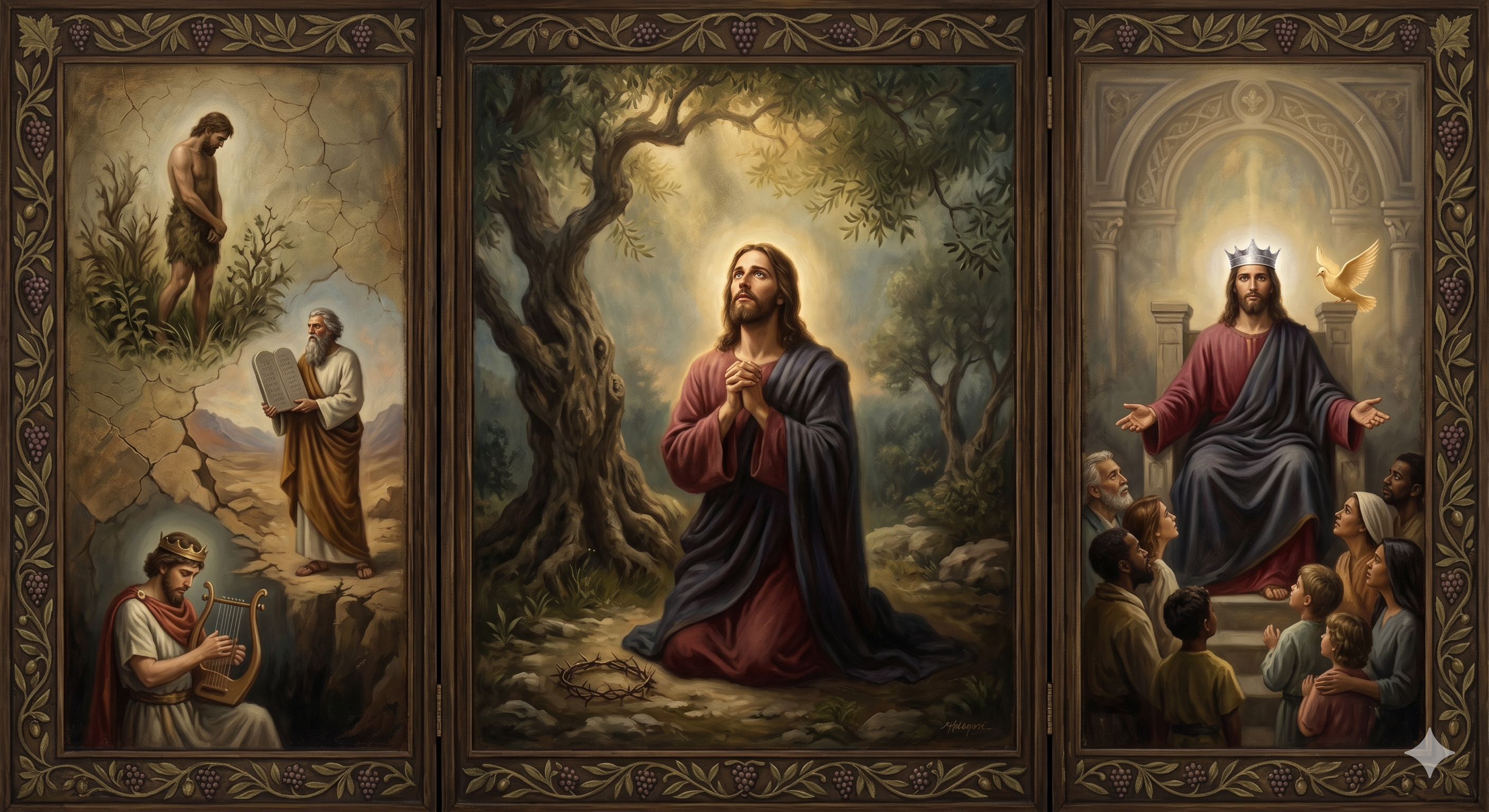
Gethsemane and the Obedience of the Faithful Son
“Although he was a Son, he learned obedience through what he suffered.” — Hebrews 5:8
The Phenomenon of the Praying Christ
The Gospels present a persistent and unavoidable portrait of Jesus of Nazareth in prayer. He does not merely speak about prayer; he actively and repeatedly withdraws to solitary places to pray (Mark 1:35; Luke 5:16). He offers thanks to God (Luke 10:21), spends entire nights in prayer before making critical decisions (Luke 6:12), and intercedes for his disciples (Luke 22:32). In these moments, Jesus addresses God as Father, expressing a continuous reliance upon the one who sent him. This portrait is so deeply embedded in the narrative fabric of the Synoptic Gospels that any attempt to explain it away as mere pedagogical display or theatrical demonstration for the benefit of onlookers does violence to the text. The evangelists depict genuine prayer.
For many readers, this narrative reality presents an immediate theological difficulty. If Jesus possesses divine identity, why does he pray to God? Historically, Christian theology has often rushed to solve this difficulty by employing later, highly developed metaphysical categories, dividing Christ's actions between his two natures or treating his prayers as an economic accommodation. While these systematic formulations have their place in historical dogma, they risk bypassing the prior, canonical question: What does prayer mean within the biblical history of human calling, covenantal sonship, faithfulness, and representation that reaches its climax in Jesus? By tracing this history, we can understand Jesus' prayers not simply as an ontological puzzle to be solved, but within the human and messianic vocation he assumed.
The Primordial Vocation: Creaturely Obedience in Genesis
The biblical history of human vocation begins in Genesis 1 and 2, where humanity is created by God and placed within the cosmos. Adam is formed from the dust, receives the breath of life, and is given a specific mandate: to exercise dominion, to cultivate the garden, and to keep it (Gen 1:26–28; 2:15). This calling is fundamentally relational. Humanity's existence is not characterized by autonomy, but by responsive life before the Creator. The boundary of this relationship is established by a direct command regarding the tree of the knowledge of good and evil (Gen 2:16–17). Keeping this command is the concrete expression of humanity's recognition of God's sovereignty.
Although Genesis does not explicitly depict Adam in the act of prayer, it establishes the essential framework of human vocation: life lived in response to the divine voice. The tragedy of Genesis 3 is not merely the breaking of a rule, but the refusal of this relationship. By grasping at autonomy, the human creature seeks to transcend the boundary established by God. This primal failure introduces a pattern of disobedience that fractures the relationship between God and humanity, setting the stage for the rest of the biblical narrative.
The fundamental human calling is therefore one of faithful response. Genesis establishes the vocation and its failure without yet identifying how that failure will be answered. The significance of this pattern for Jesus must be established by the later canonical witness rather than assumed at the beginning.
Israel as the Firstborn: Sonship under Covenantal Testing
As the canonical narrative progresses, this calling becomes concentrated within the nation of Israel. In Exodus 4:22, YHWH declares to Pharaoh, “Israel is my son, my firstborn.” This designation of sonship is not a title of static privilege; it carries a particular purpose. Israel is delivered from Egypt, brought into covenant at Sinai, and commanded to obey the voice of YHWH. Its sonship is marked by reliance upon God's provision and faithful response to his commands.
The wilderness becomes the primary arena in which Israel's sonship is tested. In Deuteronomy 8:2–3, Moses explains that YHWH led Israel through the wilderness for forty years to humble and test them, to know what was in their heart, whether they would keep his commandments. The gift of manna was intended to teach Israel that “man does not live by bread alone, but man lives by every word that comes from the mouth of the LORD.” Sonship, within this pattern, is bound to testing and the learning of trust.
Yet the biblical witness repeatedly records Israel's failure to live out this calling. Deuteronomy 32:5 describes a “crooked and twisted generation.” Isaiah 1:2 laments, “Children have I reared and brought up, but they have rebelled against me.” Hosea 11:1–2 recalls, “When Israel was a child, I loved him, and out of Egypt I called my son. The more they were called, the more they went away.” Israel, the corporate son, reproduces humanity's earlier pattern of rebellion. A canonical tension emerges: Who will live as the faithful son under testing?
The Wilderness Convergence: The Testing of the Son
The Synoptic Gospels deliberately position Jesus within this history of Israel's sonship. The connection becomes especially visible in the baptismal and temptation narratives. At his baptism, Jesus is identified by the voice from heaven as the beloved Son (Matt 3:17). Immediately afterward, he is led by the Spirit into the wilderness to be tempted by the devil (Matt 4:1). His forty days and forty nights recall Israel's forty years of wilderness testing, while also evoking Moses' forty-day fast on the mountain (Exod 34:28).
The nature of the testing is revealed in Jesus' scriptural responses to the tempter. Each comes from Israel's wilderness discourse in Deuteronomy. When commanded to turn stones into bread, Jesus quotes Deuteronomy 8:3: “Man shall not live by bread alone, but by every word that comes from the mouth of God” (Matt 4:4). When challenged to throw himself from the temple, he answers with Deuteronomy 6:16: “You shall not put the Lord your God to the test” (Matt 4:7). When offered the kingdoms of the world, he cites Deuteronomy 6:13: “You shall worship the Lord your God and him only shall you serve” (Matt 4:10).
These texts place Jesus unmistakably within Israel's history of testing. Where Israel failed amid hunger, tested YHWH at Massah, and turned toward idolatry, Jesus remains faithful. His sonship is expressed not through self-directed power but through sustained fidelity to the word of God.
Royal Sonship and Representative Intercession
Alongside Israel's corporate sonship, the Old Testament develops a pattern of royal sonship centered on the Davidic king. In the Davidic covenant, YHWH promises concerning the king, “I will be to him a father, and he shall be to me a son” (2 Sam 7:14). Psalm 2:7 similarly declares, “You are my Son; today I have begotten you.” The king is God's appointed ruler among the people and is himself required to remain subject to the divine law (Deut 17:18–20). Royal sonship therefore joins authority with accountability before God.
Israel's Scriptures also associate representative leadership with intercession. Moses pleads for Israel after the sin of the golden calf, appealing to God's covenant promises on the people's behalf (Exod 32:11–14). At the dedication of the temple, Solomon stands before YHWH and intercedes for the nation (1 Kgs 8:22–53). Prophetic figures such as Samuel and Jeremiah likewise stand before God on behalf of the people.
These precedents establish that intercessory prayer belongs naturally within Israel's scriptural patterns of representation. When Jesus prays, he is therefore not performing an anomalous act outside the biblical world from which his mission emerges. His prayers can be heard within a history in which those entrusted with God's people stand before God on their behalf.
Gethsemane: The Climax of Obedience
The trajectories of human vocation, Israelite sonship, and representation converge in Gethsemane (Matt 26:36–46; Mark 14:32–42; Luke 22:39–46). Here the evangelists present Jesus' humanity in its most acute and unvarnished reality. He is described as “sorrowful and troubled,” even “very sorrowful, even to death” (Matt 26:37–38). He falls on his face and prays.
The content of his prayer reveals the intensity of the moment: “My Father, if it be possible, let this cup pass from me; nevertheless, not as I will, but as you will” (Matt 26:39). The imagery of the “cup” has important Old Testament associations with judgment (Isa 51:17; Jer 25:15), but the immediate narrative emphasis falls upon the suffering and death Jesus is approaching. He does not face that prospect with stoic indifference. His petition expresses a genuine human recoil from what lies ahead.
Yet the prayer culminates in submission to the Father's purpose: “Not my will, but yours, be done” (Luke 22:42). Read within the wider New Testament contrast between Adam's disobedience and Christ's obedience, Gethsemane brings that contrast into particularly sharp focus. The first human transgressed the divine command; Jesus, under the extremity of suffering, remains faithful. The scene likewise gathers up the Gospel's presentation of the Son who endures testing without abandoning his calling.
Hebrews 5:7–9 provides an apostolic interpretation of this pattern. “In the days of his flesh,” Jesus “offered up prayers and supplications, with loud cries and tears, to him who was able to save him from death,” and “although he was a Son, he learned obedience through what he suffered.” The phrase “learned obedience” does not imply movement from disobedience to righteousness. Rather, the Son experiences obedience under the actual conditions and cost of suffering. “Being made perfect,” he becomes “the source of eternal salvation to all who obey him.” Prayer, suffering, sonship, and obedience meet within the same movement.
The Limits of Exegesis: Vocation and Identity
At this point, the strongest alternative reading must be taken seriously. The distinction of wills in Gethsemane, Jesus' reliance upon the Father, and his submissive posture in prayer may be taken as evidence that he is personally distinct from God and subordinate to him in a way that precludes his sharing in the unique divine identity. The argument rests upon genuine narrative features: Jesus addresses the Father, distinguishes “my will” from “yours,” and prays to the one who hears him.
A crucial distinction must nevertheless be maintained between what these prayers establish about Jesus' lived human and mediatorial vocation and what conclusions may subsequently be drawn about his ultimate identity. The Gospel narratives present his prayer, obedience, dependence, and suffering as genuine features of the human life he has assumed.
These realities do not automatically settle the larger question of his ultimate identity. Whether they exhaust that question is a separate theological inquiry requiring other canonical texts. For the present study, the exegesis must stop at the boundary of this human and mediatorial obedience.
Conclusion
The prayers of Jesus do not stand outside the biblical history of sonship; they bring that history to its decisive climax. Humanity was created to live responsively before the Creator, a calling the first human refused. Israel was named God's firstborn son and summoned to faithfulness through the wilderness, yet repeatedly rebelled. The Davidic king likewise bore a representative calling under God.
Jesus enters this unfinished history not to bypass it, but to fulfill it from within. In the wilderness, he answers the tempter from the Scriptures of Israel's testing. Throughout his ministry, he withdraws to pray. Finally, in Gethsemane, facing suffering and death, he does not evade the human condition he has assumed. He prays within it:
“Not my will, but yours, be done.”
The Son's prayer is the prayer of human obedience carried to the very end.